• The Art of ChoosingHome page
  • Fine Art Prints3 Editions
  • CollectionsAll Collections
  • AboutAmar Guillen
  • Customer Space & Contact
  • Select your language

    • English (United Kingdom)
    • Français (France)
  • All You Need to Select Your Fine Art Print
    • How to Choose a Fine Art Print - Q&A - FAQ
    • New Creations
    • Explore Some Interiors
    • Fine Art Print Blog
  • Browse by Edition
    • All Fine Art Prints
    • Unique Edition
    • Limited Edition
    • Open Edition
  • Browse by Style
    • Black and White
    • Color
    • Fusion
    • Impression
    • Back to Black
    • Landscapes in Black and White
    • Landscapes in Color
    • Animals in Black and White
    • Animals in Color
  • Browse by Theme
    • Landscape
    • Wildlife
    • Underwater
    • Abstract
    • Symbolic
    • Landscapes of the United States
    • Landscapes of France
    • Landscapes of Scotland
    • Seascapes
    • Relaxing
    • Energizing
    • Playful
  • Browse by Format
    • Rectangular
    • Square
    • Panoramic
  • Contact Me
    • Contact Me by Email or Phone
  • Collections
    • New Collections
    • All Collections
  • Browse by Theme
    • Landscapes
    • Wildlife
    • Underwater
    • Abstract
    • Symbolic
    • Landscapes of France
    • Landscapes of the United States
  • Browse by Style
    • Black and White
    • Color
    • Impression
    • Back to Black
    • Fusion
  • Contact Me
    • Contact Me by Email or Phone
  • Discover More About Me
    • Discover Who is Amar Guillen
    • Artistic and Photographic Statement
  • Galleries
    • Photo Galleries
    • Abstract Portfolio in Color
    • Black and White Landscape Photography Portfolio
    • Color Landscape Photography Portfolio
    • Black and White Wildlife Photography Portfolio
    • Color Wildlife Photography Portfolio
    • Underwater Photography Portfolio
  • Contact Me
    • Contact Me by Email or Phone
  • Your Customer Space
    • Create or Manage your Account
    • Your Download Space
    • Your Orders
  • Contact Me
    • Contact Me by Email or Phone

You are in that section: Home > Blog > Blog of the Photographic Creation Approach

Why and How: Using Lines in Nature Photography

Lines are essential elements in nature photography. They accomplish multiple goals.

In this article, I will give you the keys to incorporate the different types of lines that are available to you.

Horizontal lines on the surface of the water with warm tones create a soft and soothing photograph.

Table of Contents

  • Definition of a Line
  • Why Use Lines in Nature Photography?
  • The Guideline
  • Reading Direction Through Lines and Anchor Points
  • The Oblique Line
  • The Diagonal Line
  • The Horizontal Line
  • The Vertical Line
  • Curves and Spirals
  • Converging Lines
  • Framing and Lines
  • Finally

Definition of a Line

There are many definitions of the word line. The one that interests me most is the following:

“A line is a real or imaginary spell that separates two contiguous elements; the intersection of two surfaces. For instance: the line of the horizon.”

Why Use Lines in Nature Photography?

In nature photography, the lines are intended to direct the eyes of the viewer towards the centers of interest.

The line and its management does not have any impact on the composition of your photographs.

Rather, it represents a path for the eyes to follow in the image. It captivates the viewer's attention.

Besides serving as a visual pathway, a line can also influence mood and emotional perception. A line can divide, unify, and accentuate certain parts of a composition. There are different types of lines. Each serves a different purpose.

But how should you use the lines in a nature photograph?

I am going to explain my thoughts to you now.

Read also: why and how using shapes in photography.

The Guideline

The guideline is based on optical effects created in a photo.

It is also called the suggested line.

It is obtained by isolating a detail of the subject (coral for example). Graphic design becomes the subject. It is more cerebral. Abstraction needs the sensuality of texture to gain emotion. This is especially true in close-up photography.

It is not formalized on the photograph by a real line. It is suggested by photographic elements that give a direction that the eye will follow. It is the eye of the viewer that completes the missing elements. It is for this reason that we call it guide: it does not really exist but yet it directs towards a specific point of the photo.

For example, in a wildlife photography if animals are running in one direction, it is creating a guideline. The eye will automatically go in that direction. A row of trees oriented in a certain direction will create a guideline.

In nature photography, it is a technique that is widely used because we often find suggestive lines.

A guideline makes it possible to point out an interesting subject because it leads the look of a part towards another one of the image.

It can also go from the foreground to the background.

A guideline is most effective when it establishes a relationship between the line and the main focus of the scene.

Several guidelines can coexist in a photograph. The impact will be all the stronger.
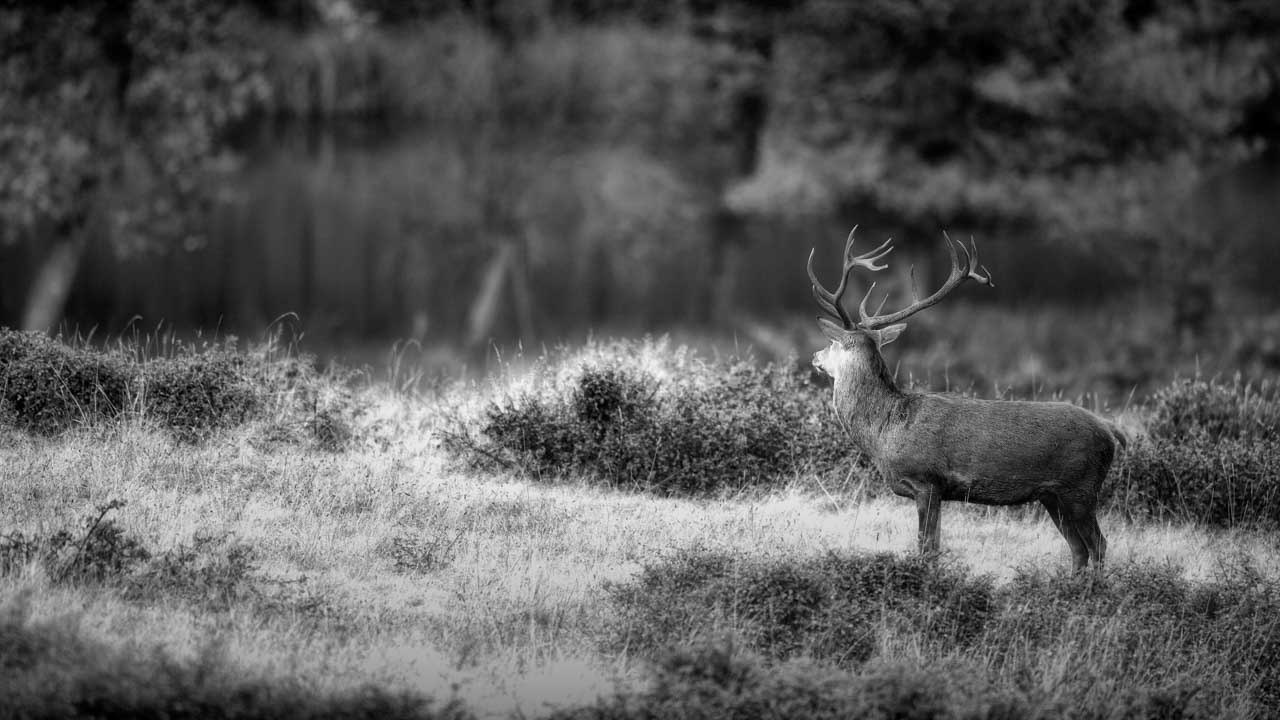
The direction in which the red deer stag looks in this black and white photo is a strong guideline.

Reading Direction Through Lines and Anchor Points

A viewer often enters into an image through an anchor. This “anchor” depends on the personal sensitivity of a viewer which he chooses. It is something that stands out to him specifically.

Once the anchor is read, the viewer then walks along the indicators provided by the photographer: lines, shapes, and masses. These indicators allow the overall understanding of the image to flow.

Lines have a role in delaying the playback of an image. As Westerners we read from left to right.

Lines and anchors allow you to delay this reading.

The Oblique Line

The oblique line is a line that may or may not be material.

It can be oriented in any direction. It is used mainly to separate a photo into two equal parts or more.

It can also be used to direct the viewer's eye to a specific point. An oblique line is one that has the most value and impact in an image.

Read also: Why and how mastering the rhythm in photography.

The Diagonal Line

The diagonal line is the one that occupies the most space in a photo because it lasts from one corner to another.

It creates proper balance between the vertical and horizontal lines. In nature photography, it is often portrayed by a movement or an animal attitude.

In underwater photography, it is a line that is very easy to create because you merely rotate the box to capture it.

Underwater space can be modified more easily than that of land.

Rotating the camera underwater to achieve a diagonal line can rarely be copied in terrestrial photography. While on land, the photographer must use natural lines to keep his camera horizontal or vertical. For example, it would be confusing to rotate an image of an animal on land, because then the ground would be slanted unnaturally.

The diagonal is a powerful line. It magnifies action and strength.

When two diagonals intersect, they have a very strong impact on a photograph because they are situated in different directions.

This gives energy to a picture. A diagonal that goes up makes you want to climb higher. The diagonal that leads from the bottom left up to the high right (the main diagonal) is the most powerful for photographers.

The secondary diagonal that goes from the top left to the bottom right is weaker and encourages more meditation.

In a photograph, when there is a horizontal line, a vertical line, and a diagonal line, it is always the latter which prevails.

A diagonal can be used in a photograph to bring dynamic movement.

The Horizontal Line

The horizontal line is the most natural for human eyes to see.

It gives us a landmark.

It brings a notion of depth, calm, and rest. It must be used in photographs that evoke serenity.

A horizontal line in a photograph implies stability and tranquility. It can be used to convey the feeling of eternity or a frozen moment of time, which is the essence of photography. It transmits a static atmosphere.

It can also be used to balance the dynamism of a diagonal line.

A horizontal line expresses solidity, anchoring the viewer to a foundation. A horizontal line placed low enough in the image makes it possible to create two distinct planes, one lesser and one greater.

It allows to create plans in a photo. Each plan may have its own colors and tones.

A horizontal line can be a real line in nature, such as the sun setting on the horizon, or it can form naturally behind the subject, like a wide backdrop. In this case, its function is to separate two different natural environments. It allows the viewer to divide a photo into different parts.

I must mention that the horizontal line can also be like a guideline, in the sense that it can easily be suggested by a natural phenomenon. But be careful, for suggestive lines have less impact than the actual lines.

Read also: Why and how mastering tonality in photography.

The Vertical Line

The vertical line is more powerful than the horizontal line. It brings a dimension of action and strength. It can also be real or directive.

It encourages the eye to go from bottom to top, upwards and downwards to explore every inch of the image. It is well suited to a portrait format.

A vertical line transmits power, size, and/or height.

It can be perceived as rigid, because it sets limits. It contributes to the two-dimensional sensation of the image. This is the opposite effect of the diagonal.

Curves and Spirals

A curve, such as a spiral, allows the viewer to travel in the picture. With the rows divided into parts, each row may have its own subject. This allows the photographer to highlight hidden items.

Straight lines directly guide the eye and are stronger. Curves allow the photographer to be more evasive and more evocative.

Converging Lines

Convergent lines convey depth, breadth, and distance. They allow the photographer to display a world in three dimensions with a photo that is in two dimensions. Convergent lines which are well placed may direct the gaze towards a subject.

For example, in nature photography, you may capture two paths that converge towards a specific point of a photo. Clouds can also direct the gaze towards a point of convergence.

Framing and Lines

The vertical or horizontal framing will reinforce or oppose the direction of the lines. This phenomenon creates a tension in the image. A photographer must always think carefully about the types of lines that he introduces into a photo according to the framing. The framing will ultimately filter the level of impact the lines give to the photograph.

Finally

I hope that this article convinces you that lines are essential elements to invigorating your pictures by making them more interesting.

While lines may divide or separate a scene, they may also direct the viewer’s gaze towards specific points of a photo.

Feel free to use lines creatively in your work.

Be humble, patient, constant, persevering, and persistent because the road to excellence is long.

Why and How: Using Shapes in Nature Photography

Shapes can also be referred to as “optical surfaces”. They result from the combination of lines and angles. In nature photography, they can be real or implied.

In this article, I show you how to take advantage of using shapes to create interesting and creative photos.

The shape of the triangle between sailfish and sardines reinforces the reading of the image.

Table of Contents

  • Definition of a Form
  • Why Use Shapes in Nature Photography?
  • The Three Properties of a Shape
  • The Role of Light
  • Some Rules of Using Shapes
  • Triangles
  • Squares
  • Curves and Ovals
  • Rectangles
  • Silhouettes
  • Finally

Definition of a Form

A shape exists as a being or object, both which possess lines, mass, contours, and often, a silhouette that we may struggle to recognize.

We can also define a shape by the way it materializes. We may talk about its appearance or the state in which it is presented.

Why Use Shapes in Nature Photography?

Geometric shapes are fundamental elements of a photograph. With the colors and tones, they are the elements which you really need.

As soon as we start to perceive a photograph as a set of geometric shapes, tones, and colors, we stop imagining it from our own detailed perspective and analyze its basic structure, or skeleton.

For example, a fish or an animal is no longer seen as a portrait but as a series of geometric shapes. You must add the emotional expressions, the texture of the fur, plumage, or scales, and play with the light to produce a quality picture.

The combination of different elements facilitates viewers’ reading and understanding of the image. You will add geometric shapes as elements to help guide the eyes of your audience.

Shapes structure your composition, guiding the gaze along the leading lines which channel towards the centers of interest.

Although you can elevate volume with shadows and lights, you still need the vitality of shapes.

You must learn to spot geometric shapes in a photograph, and frame them to convey your message.

Of course, geometric shapes can take on many forms, such as horizontal lines, vertical lines, squares, circles, and unspoken lines (as suggested off frame).

Read also: Why and how mastering the rhythm in photography.

The Three Properties of a Shape

As a nature photographer, you must always keep them in mind when creating a photograph.

The properties of shapes allow you to better analyze a scene and to decide whether a shape should be integrated into an image.

  • Mass: it describes the amount of space filled by a shape. It qualifies the heaviness and the size of this space.
  • Proportion: it defines how the mass of one photographic element is comparable to another. It is the comparison of weights between several forms.
  • The relationship: it defines how forms interact with each other in a photograph.

The Role of Light

Quality light management is essential for highlighting shapes. It will give the 3D effect that we always look for in photography.

One advantage of nature photography is that the natural light is nearly perfect. A grazing light can highlight the entirety of one form or create additional ones in a suggestive way.

A properly lit shape can become dominant if placed against contrasting backgrounds.

Some Rules of Using Shapes

To emphasize one form over another in a photograph, you merely eliminate attributes like textures and details. The form becomes easily identifiable by its contrast, and its impact is very strong.

When photographic elements connect to each other in a photo, shapes catch the eye of the viewer, attracting the gaze from one point of interest to another.

If a composition lacks shapes, then it becomes difficult to read and understand.

Negative space can be used to describe a shape by outlining its circumference without ever directly revealing it. Suggestion is key in art of photography.

Read also: Why and how mastering tonality in photography.

Triangles

The triangle is a form that brings balance to a photograph. It is the strongest and most basic form.

The triangle is the shape that creates the most impact.

  • If the main focus of a photograph is a triangle, the viewer's attention will directly focus on it. It is a form that can be suggested through different points. One does not need to have a particular organization. Triangles do not need to be equilateral.
  • If none of the sides of a triangle is parallel to one of the edges of the photo, the photo evokes a sense of calmness.
  • If one of the sides of a triangle is parallel to one of the edges of the photo, it reinforces a feeling of direct solidity. It promotes movement from the base to the summit.
  • If the tip of a triangle is directed upwards, then this form suggests a rise in emotion.
  • The ascending triangle is a harmonious form that provides a sense of calm and balance. It is a form that evokes spirituality because the summit points to the sky.

Triangle shapes are numerous in nature. We may think of mountains when we see triangles in nature.

If the tip of a triangle is pointing downwards then this shape suggests an imbalance.

The descending triangle accelerates the movement of the eyes and gives an impression of insecurity.

Squares

This form strengthens balance and rigidity. It is hard to concretely find it in nature. It is easier to suggest it with several different elements.

The square is a very symmetrical form. It leaves a great amount of space around it.

It must always be combined with other forms.

Curves and Ovals

These shapes are special because they easily accept the centering of the main photographic elements and their radiation. They evoke softness and serenity. Like the square, a round form leaves much space around it.

The circle symbolizes infinity, sweetness, harmony. It gives the impression of a perfect balance.

A circle in a photograph is easy to notice. It needs to be visibly marked. It has a relaxing and pleasant effect.

A circle in a photograph is easy to notice. It needs to be well marked and visible. It has a relaxing and pleasant effect.

Rectangles

The rectangle is a rare form in nature, but it is very useful for subdividing a photo.

The horizontal corner recalls a peaceful atmosphere of rest. But it can also provide a feeling of heaviness and coldness.

The vertical rectangle expresses power, strength, and solidarity. It can be used to dramatize a composition.

Silhouettes

The silhouette is a very powerful and aesthetic form. The silhouette of an unknown form is interesting and provocative. Its impact is much stronger than known forms. Silhouettes are very emotional.

Finally

My advice to you is to learn the advantages and disadvantages of the different forms available in nature. These forms will allow you to compose impactful and interesting scenes.

Be humble, patient, constant, persevering, and persistent because the road to excellence is long.

  1. Why and How: Mastering Tonality in Nature Photography
  2. Why and How: Mastering Rhythm in Nature Photography
  3. Why and How: Photographing the Bugle of Deer in Black and White
  4. Being Able to Judge Your Own Photos Is a Quality to Be a Good Photographer

Page 64 of 201

  • 59
  • 60
  • 61
  • 62
  • 63
  • 64
  • 65
  • 66
  • 67
  • 68
  1. You are here:  
  2. Home
  3. Blog Photographic Approach

Share on Social Media

Post
Share
Share
E-mail
WhatsApp
Text

Join Me on Social Networks

Join Me on Facebook  Join Me on Instagram  Join Me on LinkedIn

Claim your free guide to make your photo impactful and meaningful

Claim Your Free Guide '50 Pages of Tips to Give Impact and Meaning to Your Photos'.

4 + 8 =

Click Here To Discover All My Chronicles About the Photographic Approach.

Treat Yourself to a Fine Art Print That Matches your Personality

Example of a vacation home interior with a black and white fine photo art displayed on the wall.

Fine Art Print Collections in Black and White

Fine Art Print Collections in Black and White Black and white photography is a suitable technique for many nature scenes. It requires a particular frame of mind. A black and white photograph should be prepared and planned from the framing to the…
12004
Fine Art Print Collections in Black and White
An abstract art photo displayed in a contemporary living room decor.

Fine Art Print Collections in Color

Collections of Fine Art Prints in Color Color photographs allow digressions and take the audience to the message by secondary ways. The world around us, especially nature, is colorful. A color image can show the way our surroundings really are. Of course, it…
10448
Fine Art Print Collections in Color
Example of a home interior with fine art prints in my style back to black displayed on the wall. These photos are a part of my collection 'Wild beauties of Kenya'.

Fine Art Print Collections in Back to Black

Fine Art Print Collections in Back to Black I want to share my fine art prints of nature in a personal style that I call "back to black." "Back to Black" was developed to embody a sharp and clean style for artistic photos that can be hung in your living room,…
9987
Fine Art Print Collections in Back to Black
A waiting room with a photo in the style Fusion displayed on the wall. Grey Heron in Fusion.

Fine Art Print Collections with the Fusion Style

Fine Art Print Collections with the Fusion Style I would like to share a very creative and modern photography style to represent Nature in a very different way. I call it "Fusion." I created the style to offer dynamic photos, allowing you to start a good day…
7917
Fine Art Print Collections with the Fusion Style
A living room with a photo in the style 'Impression' exposed on the wall. Rising sun in impression

Fine Art Print Collections with the ‘Impression’ Style

Fine Art Print Collections with the ‘Impression’ Style The objective of this photographic style is to create the ephemeral blurs. That's why I named it 'Impression.' Photography, as an art form, is a powerful means of expressing reality from different…
5831
Fine Art Print Collections with the ‘Impression’ Style
Fine art prints from the style back to black displayed on a wall. Amar Guillen, photographer artist

New Collections of Fine Art Prints Dedicated to the Wonders of Nature

New and Updated Fine Art Print Collections Dedicated to the Wonders of Nature Fine art prints from the style back to black displayed on a wall.
11451
New Collections of Fine Art Prints Dedicated to the Wonders of Nature

Themes of the Blog Articles

Landscape of Arches National Park in Utah in black and white.

Blog Articles Dedicated to Artist Statement

Blog Articles Dedicated to Artist Statement
Dunes of death Valley in Black and White

Blog Articles Dedicated to Black and White Photography

Blog Articles Dedicated to Black and White Photography
Abstract photo or trees reflection on water

Blog Articles Dedicated to Photographic Mindset

Blog Articles Dedicated to Photographic Mindset
Abstract photo of ridles on water

Blog Articles Dedicated to Artistic Photography

Blog Articles Dedicated to Artistic Photography
Abstract photo of Yellowstone

Blog Articles Dedicated to Photographic Language

Blog Articles Dedicated to Photographic Language
Pronghorn in Yellowstone

Blog Articles Dedicated to Wildlife Photography

Blog Articles Dedicated to Wildlife Photography
Landscape of Bryce Canyon

Blog Articles Dedicated to Photographing United States

Blog Articles Dedicated to Photographing United States
Underwater waves in the Red Sea

Blog Articles Dedicated to Photographic Techniques

Blog Articles Dedicated to Photographic Techniques
Tree of Black Canyon in Black and White

Blog Articles Dedicated to Landscape Photography

Blog Articles Dedicated to Landscape Photography
Manta Ray in Maldives in Black and White

Blog Articles Dedicated to Underwater Photography

Blog Articles Dedicated to Underwater Photography
Red Deer stag during the rut of the deer

Blog Articles Dedicated to Photographic Judgement

Blog Articles Dedicated to Photographic Judgement
Great Crested Greb and his chick

Unclassified Blog Articles

Unclassified Blog Articles

You Might Be Interested By One of These Photographic Approach Articles

Mustangs in a meadow near Grand Teton in the national park in Wyoming.

Use a Slideshow to Tell a Story with your Photos

4915
Use a Slideshow to Tell a Story with your Photos
A photo of a gelada, taken on a cliff in Ethiopia. This picture was taken during a photo walk.

Photographing at Eye Level to Improve your Wildlife Photos

4441
Photographing at Eye Level to Improve your Wildlife Photos
Photograph in black and white of a manta ray in Maldives during a night dive. Photograph by Amar Guillen, photographer artist.

Why and How Judging a Photograph Subjectively

4233
Why and How Judging a Photograph Subjectively
Landscape in black and white of the Sand Dunes in Death Valley. Photograph by Amar Guillen, photographer artist.

15 Steps to Improve Your Photos

3448
15 Steps to Improve Your Photos

Receive Free Tips On How to Give Impact and Meaning to Your Photos. Subscribe to Receive Regular Articles.

2 + 7 =

Contact Me By Email

10 + 9 =
This site is protected by reCAPTCHA and the Google Privacy Policy and Terms of Service apply.

About Amar Guillen, Creator of Fine Art Prints of Nature
As a photographer capturing the artistic essence for several decades, I have mastered the art of crafting an authentic experience for art enthusiasts and collectors of visual art.
When I observe my surroundings, be it friends, family, relationships, or professional contacts, I see souls in perpetual motion. Every moment of their existence is engulfed by daily hassles, work concerns, social media, online or televised information streams, and videos on the web.
Every minute, they strive to accomplish something, fearing losing ground and feeling marginalized in this frenzied society. Imprisoned by an oppressive schedule, the essential eludes them, drowned in the tumult of daily life. Is it really crucial to watch yet another cat video on the internet? Is it necessary to post twenty daily messages on social media?
Despite this, they remain constantly stressed and anxious about the challenges of the world, without being able to influence these monumental problems. It is at this moment that my artistic nature photographs come into play. Those who have had the privilege of hanging one of my works in their personal or professional space have expressed a radical transformation in their lives.
Every day, contemplating these works of art immerses them in tranquility, inner peace, and rediscovered serenity. They then understand that nature has the power to unravel tensions, to encourage reflection on the essential. Artistic photographs thus become open windows to the wonders of nature.
I have chosen to share the best of myself by helping others discover their identity, personality, style, all while reconnecting with nature. Take the time to explore my artistic photographs if you wish to reveal your true essence. Once hung in your space, your view of the world will be transformed.
Amar Guillen is a creator of fine art prints of nature.
I am Amar Guillen, creator of nature art photographs. I have a deep conviction that contemplating nature has the power to transform human beings. If everyone learned to know, respect, and preserve nature, our world would be transformed into a haven of peace where everyone would find their place.
Copyright © 2003 - 2026 Guillen Photo LLC - All rights reserved. Amar Guillen, professional photographer since 2003.
  • Blog
  • Calibration
  • Legal Information
  • Sitemap
  • Accessibility
  • Contact Me
  • Updates of the Website
I Want to Help You to Create Interesting Photos

How Can I Help You To Create More Interesting Photos?

Ask Me a Technical Question.
Subscribe to my Newsletter. The Inspiration Behind Guillen Photo.

Select your language

  • English (United Kingdom)
  • Français (France)
Claim your free guide to make your photo impactful and meaningful

Claim Your Free Guide '50 Pages of Tips to Give Impact and Meaning to Your Photos'.

3 + 8 =

Contact Me By Email

4 + 1 =

Office Address:
3512 Robin Road
Plano Texas 75075
USA

Office phone: (+1)214-769-6825