• The Art of ChoosingHome page
  • Fine Art Prints3 Editions
  • CollectionsAll Collections
  • AboutAmar Guillen
  • Customer Space & Contact
  • Select your language

    • English (United Kingdom)
    • Français (France)
  • All You Need to Select Your Fine Art Print
    • How to Choose a Fine Art Print - Q&A - FAQ
    • New Creations
    • Explore Some Interiors
    • Fine Art Print Blog
  • Browse by Edition
    • All Fine Art Prints
    • Unique Edition
    • Limited Edition
    • Open Edition
  • Browse by Style
    • Black and White
    • Color
    • Fusion
    • Impression
    • Back to Black
    • Landscapes in Black and White
    • Landscapes in Color
    • Animals in Black and White
    • Animals in Color
  • Browse by Theme
    • Landscape
    • Wildlife
    • Underwater
    • Abstract
    • Symbolic
    • Landscapes of the United States
    • Landscapes of France
    • Landscapes of Scotland
    • Seascapes
    • Relaxing
    • Energizing
    • Playful
  • Browse by Format
    • Rectangular
    • Square
    • Panoramic
  • Contact Me
    • Contact Me by Email or Phone
  • Collections
    • New Collections
    • All Collections
  • Browse by Theme
    • Landscapes
    • Wildlife
    • Underwater
    • Abstract
    • Symbolic
    • Landscapes of France
    • Landscapes of the United States
  • Browse by Style
    • Black and White
    • Color
    • Impression
    • Back to Black
    • Fusion
  • Contact Me
    • Contact Me by Email or Phone
  • Discover More About Me
    • Discover Who is Amar Guillen
    • Artistic and Photographic Statement
  • Galleries
    • Photo Galleries
    • Abstract Portfolio in Color
    • Black and White Landscape Photography Portfolio
    • Color Landscape Photography Portfolio
    • Black and White Wildlife Photography Portfolio
    • Color Wildlife Photography Portfolio
    • Underwater Photography Portfolio
  • Contact Me
    • Contact Me by Email or Phone
  • Your Customer Space
    • Create or Manage your Account
    • Your Download Space
    • Your Orders
  • Contact Me
    • Contact Me by Email or Phone

You are in that section: Home > Blog > Blog of the Photographic Creation Approach

Why and How: Using the Figures of Style in Nature Photography

Have you ever tried using zeugma or synecdoche in your nature photographs? I am sure that you have; however, you may have used them without understanding their technical name and purpose.

These two techniques are only part of a fascinating world that I use to build my photographs: the figures of style.

In this article, I will give you the tools you need to create your own photos with figures of style.

An example of Zeugma I used to create a photograph.

Table of Contents

  • Definition of a Figure of Style
  • Why Use Figures of Style in Photography?
  • The Alliteration
  • The Antithesis
  • The Ellipse
  • The Metaphor
  • Hyperbola
  • The Synecdoche
  • The Inversion
  • The Zeugma
  • Finally

Definition of a Figure of Style

A figure of style is a process that acts on the language and creates an effect of meaning or sound.

You can see that the definition of a figure of style refers to its spoken or written language. You must not forget that photography is only a means of expression, which I have explained in several articles.

I will therefore transcribe the figures of style from a written or spoken language into the visual language of photography.

Why Use Figures of Style in Photography?

The figures of style make it possible to catch the attention of the viewer. They also reinforce the meaning you want to give to a photograph and its aestheticism. The figures of style in photography have their roots in spoken or written language, which is also referred to as “rhetoric”.

Read also: why and how using shapes in photography.

The Alliteration

In spoken or written language, an alliteration is the repetition of one or more consonants. For example, for “his snakes are slithering by his side". The letter ‘s’ is an alliteration. It has a rhythmic effect. Alliteration is used to make names easy to remember, for example, Bugs Bunny or Donald Duck.

In photography, words are preserved through images to evoke a similar effect. This may be displayed through the repetition of a defined space in a photo, which is the most common method. The photographer can recreate visual rhymes that draw attention from the viewer’s gaze.

For example, the shape of stratified stone may be repeated in a photo.

Alliteration is a very creative effect in photography that adds depth to the aesthetic qualities of an image.

The Antithesis

In spoken and written language, the antithesis consists in uniting two thoughts, expressions, or words in the same statement to emphasize a strong contrast. For example, Voltaire wrote "Sad lover of the dead, she hates the living". Both expressions are antagonistic due to the words of “love” and “hate”, “death” and “life”.

Antithesis is the opposition of elements in a photo. For example, black and white are two opposite colors.

Opposition can also come from tonalities. When in a photo of nature, we create strong contrasts to highlight certain forms, we play on the effects of antithesis.

This technique should be used moderately and wisely. A strong tonal contrast in a photo does not necessarily mean that, with antithesis, the photographer should fit the image to a specific frame. Rather than defining the image, antithesis reinforces certain elements. The process of incorporating antithesis is not particularly aesthetic, but it improves the aesthetic reading of a photograph.

The Ellipse

In spoken or written language, the ellipse is a figure of style that consists of omitting one or more elements to better understand the text. This creates a “shortening” effect. It forces the receiver to mentally restore what the author has removed or ignored. For example, Eugene Delacroix wrote "I do not advance so much. The time does". The word “advance” is omitted in the second sentence, but the reader mentally adds it, so that it is interpreted as “The time does advance.”

In photography the ellipse is also known as being “out of field”. The photographic element may be absent from the photograph. Yet the lines converge to this point which the viewer cannot see.

It is a technique that is used often in animal photography. An animal looks in one direction, but we do not see what its gaze rests upon.

Read also: Why and how mastering tonality in photography.

The Metaphor

In spoken or written language, a metaphor is a process of assigning different meanings to one word, thus creating a similarity or analogy.

For example, in underwater photography, a brain coral can be perceived as the brain of a human being, however, it is still an underwater creature.

Hyperbola

In spoken or written language, hyperbola is a figure of speech that exaggerates the expression of an idea or a reality in order to highlight it. If often has a negative or unpleasant connotation.

In photography, hyperbola is a process that exaggerates the size of the forms or the photographic elements. To use hyperbola, simply use a wide-angle lens when shooting and position yourself close to the element. Your subject of the image will become distorted and will seem to have drastically increased in size.

Read also: Why and how mastering the rhythm in photography.

The Synecdoche

In spoken or written language, synecdoche is a figure used to describe the relation between a given term and what the term evokes, constituting an inclusion of material or a conceptual dependence. For example, we may say "the bike is punctured” when in truth, it is merely the inner tube of the wheel. We may say that “the train spits black smoke” meaning that smoke billows up from the chimney.

In photography, synecdoche means to frame part of one scene to express a whole idea.

The best example is that of the eye of an animal. The viewer will immediately identify the eye and the animal to which it belongs. One eye reveals the expression of an animal without even showing the entire creature.

The Inversion

In spoken or written language an inversion is a deliberate change in the natural order of words.

In photography, inversion is captured by changing the normal order of photographic elements. For example, the sky may become the earth.

Read also: Why and how using lines in photography.

The Zeugma

This is a form of an ellipse. The zeugma is a figure of speech to be linked by the syntax of two words, or groups of words in which only one logically relates to the verb. The two syntactically related words may be incompatible because one is abstract and the other concrete. For example, one may say that a book is “full of charm and drawings" even though it is impossible for an inanimate object to evoke charm. Or we may say that "he pulled a question out of his hat" when the speaker merely meant that the person responded quickly. A Zeugma may relate to the different meanings of a verb: "Remember this date and this place on the train", meaning that the person should remember the exact numbered day, or the memory associated with that day. A well-known example is given by Victor Hugo with the line, "Dressed in candid probity and white linen."

In photography, the zeugma consists of superimposing multiple points of life. This is replicated in photography with the technique of overprinting, where two images are depicted in one.

Finally

Like lines or shapes, figures of speech are elements that make photographs creatively convey messages or emotions. Figures of speech focus a viewer’s gaze, reinforcing the reading of an image.

Be humble, patient, constant, persevering, and persistent because the road to excellence is long.
Why and How: Mastering Perspective in Nature Photography

Using perspective in photography is essential. This is one way that can give effect 3D in your pictures.

Mastering this technology puts strengthen reading of a photograph by a viewer. The techniques are simple and easy to practice.

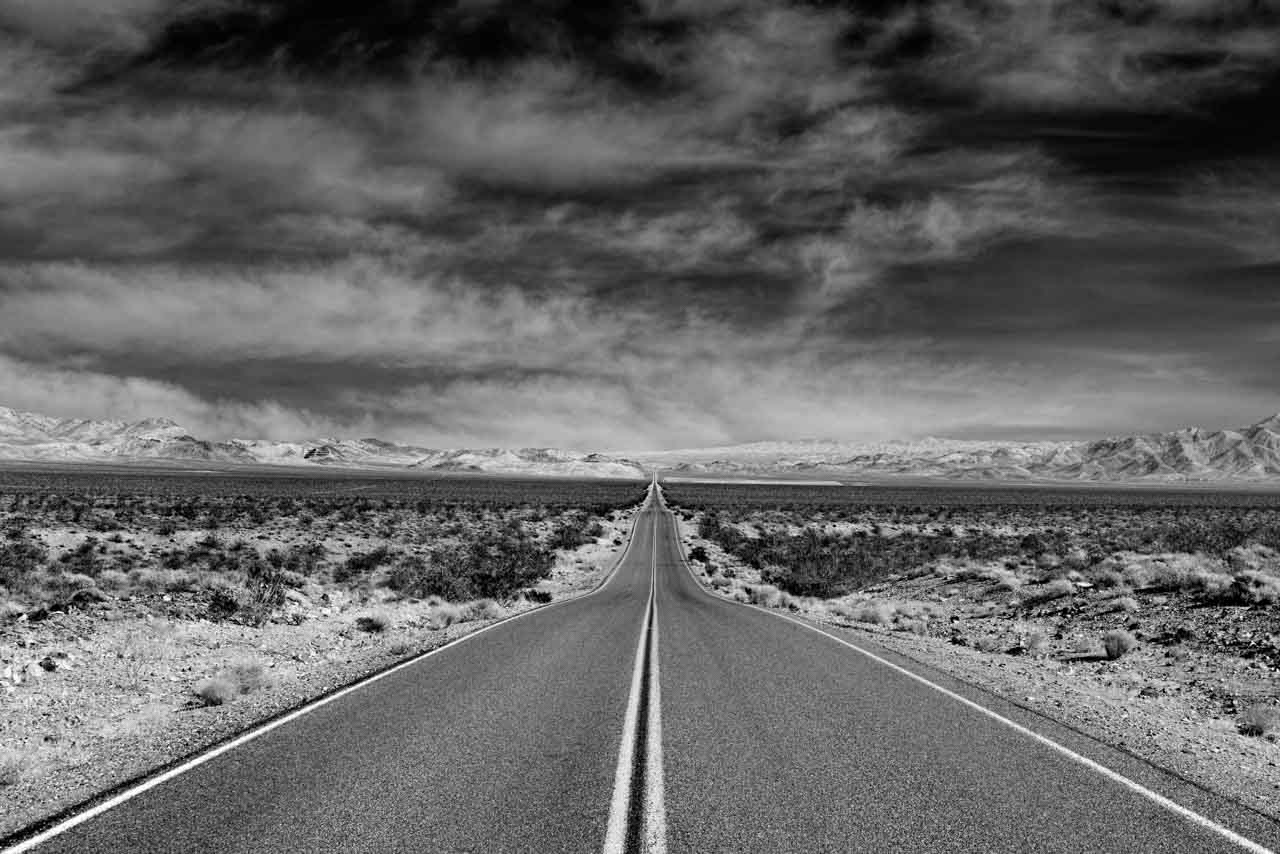
An example of perspective: a road in California in black and white. The depth effect is striking.

Table of Contents

  • Definition of Perspective in Photography
  • The Linear Perspective
  • The Rectilinear Perspective
  • The Height
  • The Decrease of the Size
  • Finally

Definition of Perspective in Photography

In photography, perspective is a technique for representing three-dimensional shapes in a photo. This technique makes it possible to account for volumes on a plan.

You should never lose sight of the fact that a photograph always shows a three-dimensional space on a two-dimensional support.

In photography, the use of perspective will allow you to show shapes, space, depth and distance. It uses the lines of flight which are often convergent.

In photography, perspective can be used in an expansive or compressive way.

The Linear Perspective

Linear perspective is defined when a viewer observes a photograph and his eye estimates distances by the size of the photographic elements and by the angle at which lines and planes converge.

The determining factors that affect the linear perspective are the distance between the lens and the main center of interest as well as the focal distance.

Linear perspective can be changed by changing the position of the camera or you can change the point of view as I had explained in this article.

You can change the apparent point of view (which is different from the real point of view) only by changing the focal length of the lens.

Read also: Why and how choosing a good point of view in nature photography.

The Rectilinear Perspective

The perspective produced by a camera is identical to that one produced by the human eye. This means that all the photographic elements have the same appearance in the photo as in the real scene.

But as you know, a lens is curved. It therefore produces a distortion of the straight lines. This is even more true with fisheye lenses that have an angle of 180 degrees.

The wide angles produce a false perspective. The lines are curved around the edges of the image. But the parallel lines give the impression of converging towards a fixed point located at infinity. These are definable points of view. This is called rectilinear perspective.

L’allitération est un effet très créatif en photo. Elle a surtout un rôle esthétique.

The Height

The height also gives an important perspective in a landscape scene, there are two dominant zones: the ground and the horizon.

The closer a photographic element is to the horizon, the more distant and smaller it will appear.

The closer an element is to the lens, the further away from the horizon, the larger it appears.

It is a simple technique that you can use to modulate the size of a shape in a photograph.

The Decrease of the Size

You are like all human beings. You are able to live experiences and memorize them. All the accumulation of these experiences allows you to keep the references of the size of the shapes and objects observed.

Take the concrete example of a photograph of a roe deer. In reality, the size at the withers of this animal is between 60 and 70 centimeters. When a photograph is taken very closely, the viewer has the impression that the size can be double. But the human eye automatically performs the correction because the brain calls on lived experience.

The size of all the familiar shapes in a photo makes it possible to establish a scale and give dimension to the scene photographed.

For example, you can play with the viewer by placing a small point of interest in the foreground and a larger point of interest in the background. The viewer will feel that the size of the primary subject is larger than the size of the second center of interest, even if in reality it is false. But the viewer will not be shocked by this difference because he will make the correction himself through his experience.

This is how you can create very interesting visual effects to create different photos.

Finally

I recommend to you to know the nature of the different perspectives and their impact on reading a photograph.

You will be able to create more creative, more dynamic and different images. You should not hesitate to use it.

But beware because sometimes the results produced can be contrary to the desired effect: your photos can become not readable.

Photography is like life. You must be able to show creative intelligence and balance your photographs.

Be humble, patient, constant, persevering, and persistent because the road to excellence is long.

  1. Why and How: Using Lines in Nature Photography
  2. Why and How: Using Shapes in Nature Photography
  3. Why and How: Mastering Tonality in Nature Photography
  4. Why and How: Mastering Rhythm in Nature Photography

Page 63 of 201

  • 58
  • 59
  • 60
  • 61
  • 62
  • 63
  • 64
  • 65
  • 66
  • 67
  1. You are here:  
  2. Home
  3. Blog Photographic Approach

Share on Social Media

Post
Share
Share
E-mail
WhatsApp
Text

Join Me on Social Networks

Join Me on Facebook  Join Me on Instagram  Join Me on LinkedIn

Claim your free guide to make your photo impactful and meaningful

Claim Your Free Guide '50 Pages of Tips to Give Impact and Meaning to Your Photos'.

4 + 8 =

Click Here To Discover All My Chronicles About the Photographic Approach.

Treat Yourself to a Fine Art Print That Matches your Personality

Example of a vacation home interior with a black and white fine photo art displayed on the wall.

Fine Art Print Collections in Black and White

Fine Art Print Collections in Black and White Black and white photography is a suitable technique for many nature scenes. It requires a particular frame of mind. A black and white photograph should be prepared and planned from the framing to the…
12004
Fine Art Print Collections in Black and White
An abstract art photo displayed in a contemporary living room decor.

Fine Art Print Collections in Color

Collections of Fine Art Prints in Color Color photographs allow digressions and take the audience to the message by secondary ways. The world around us, especially nature, is colorful. A color image can show the way our surroundings really are. Of course, it…
10448
Fine Art Print Collections in Color
Example of a home interior with fine art prints in my style back to black displayed on the wall. These photos are a part of my collection 'Wild beauties of Kenya'.

Fine Art Print Collections in Back to Black

Fine Art Print Collections in Back to Black I want to share my fine art prints of nature in a personal style that I call "back to black." "Back to Black" was developed to embody a sharp and clean style for artistic photos that can be hung in your living room,…
9987
Fine Art Print Collections in Back to Black
A waiting room with a photo in the style Fusion displayed on the wall. Grey Heron in Fusion.

Fine Art Print Collections with the Fusion Style

Fine Art Print Collections with the Fusion Style I would like to share a very creative and modern photography style to represent Nature in a very different way. I call it "Fusion." I created the style to offer dynamic photos, allowing you to start a good day…
7917
Fine Art Print Collections with the Fusion Style
A living room with a photo in the style 'Impression' exposed on the wall. Rising sun in impression

Fine Art Print Collections with the ‘Impression’ Style

Fine Art Print Collections with the ‘Impression’ Style The objective of this photographic style is to create the ephemeral blurs. That's why I named it 'Impression.' Photography, as an art form, is a powerful means of expressing reality from different…
5831
Fine Art Print Collections with the ‘Impression’ Style
Fine art prints from the style back to black displayed on a wall. Amar Guillen, photographer artist

New Collections of Fine Art Prints Dedicated to the Wonders of Nature

New and Updated Fine Art Print Collections Dedicated to the Wonders of Nature Fine art prints from the style back to black displayed on a wall.
11451
New Collections of Fine Art Prints Dedicated to the Wonders of Nature

Themes of the Blog Articles

Landscape of Arches National Park in Utah in black and white.

Blog Articles Dedicated to Artist Statement

Blog Articles Dedicated to Artist Statement
Dunes of death Valley in Black and White

Blog Articles Dedicated to Black and White Photography

Blog Articles Dedicated to Black and White Photography
Abstract photo or trees reflection on water

Blog Articles Dedicated to Photographic Mindset

Blog Articles Dedicated to Photographic Mindset
Abstract photo of ridles on water

Blog Articles Dedicated to Artistic Photography

Blog Articles Dedicated to Artistic Photography
Abstract photo of Yellowstone

Blog Articles Dedicated to Photographic Language

Blog Articles Dedicated to Photographic Language
Pronghorn in Yellowstone

Blog Articles Dedicated to Wildlife Photography

Blog Articles Dedicated to Wildlife Photography
Landscape of Bryce Canyon

Blog Articles Dedicated to Photographing United States

Blog Articles Dedicated to Photographing United States
Underwater waves in the Red Sea

Blog Articles Dedicated to Photographic Techniques

Blog Articles Dedicated to Photographic Techniques
Tree of Black Canyon in Black and White

Blog Articles Dedicated to Landscape Photography

Blog Articles Dedicated to Landscape Photography
Manta Ray in Maldives in Black and White

Blog Articles Dedicated to Underwater Photography

Blog Articles Dedicated to Underwater Photography
Red Deer stag during the rut of the deer

Blog Articles Dedicated to Photographic Judgement

Blog Articles Dedicated to Photographic Judgement
Great Crested Greb and his chick

Unclassified Blog Articles

Unclassified Blog Articles

You Might Be Interested By One of These Photographic Approach Articles

Mustangs in a meadow near Grand Teton in the national park in Wyoming.

Use a Slideshow to Tell a Story with your Photos

4915
Use a Slideshow to Tell a Story with your Photos
A photo of a gelada, taken on a cliff in Ethiopia. This picture was taken during a photo walk.

Photographing at Eye Level to Improve your Wildlife Photos

4441
Photographing at Eye Level to Improve your Wildlife Photos
Photograph in black and white of a manta ray in Maldives during a night dive. Photograph by Amar Guillen, photographer artist.

Why and How Judging a Photograph Subjectively

4233
Why and How Judging a Photograph Subjectively
Landscape in black and white of the Sand Dunes in Death Valley. Photograph by Amar Guillen, photographer artist.

15 Steps to Improve Your Photos

3448
15 Steps to Improve Your Photos

Receive Free Tips On How to Give Impact and Meaning to Your Photos. Subscribe to Receive Regular Articles.

2 + 7 =

Contact Me By Email

10 + 9 =
This site is protected by reCAPTCHA and the Google Privacy Policy and Terms of Service apply.

About Amar Guillen, Creator of Fine Art Prints of Nature
As a photographer capturing the artistic essence for several decades, I have mastered the art of crafting an authentic experience for art enthusiasts and collectors of visual art.
When I observe my surroundings, be it friends, family, relationships, or professional contacts, I see souls in perpetual motion. Every moment of their existence is engulfed by daily hassles, work concerns, social media, online or televised information streams, and videos on the web.
Every minute, they strive to accomplish something, fearing losing ground and feeling marginalized in this frenzied society. Imprisoned by an oppressive schedule, the essential eludes them, drowned in the tumult of daily life. Is it really crucial to watch yet another cat video on the internet? Is it necessary to post twenty daily messages on social media?
Despite this, they remain constantly stressed and anxious about the challenges of the world, without being able to influence these monumental problems. It is at this moment that my artistic nature photographs come into play. Those who have had the privilege of hanging one of my works in their personal or professional space have expressed a radical transformation in their lives.
Every day, contemplating these works of art immerses them in tranquility, inner peace, and rediscovered serenity. They then understand that nature has the power to unravel tensions, to encourage reflection on the essential. Artistic photographs thus become open windows to the wonders of nature.
I have chosen to share the best of myself by helping others discover their identity, personality, style, all while reconnecting with nature. Take the time to explore my artistic photographs if you wish to reveal your true essence. Once hung in your space, your view of the world will be transformed.
Amar Guillen is a creator of fine art prints of nature.
I am Amar Guillen, creator of nature art photographs. I have a deep conviction that contemplating nature has the power to transform human beings. If everyone learned to know, respect, and preserve nature, our world would be transformed into a haven of peace where everyone would find their place.
Copyright © 2003 - 2026 Guillen Photo LLC - All rights reserved. Amar Guillen, professional photographer since 2003.
  • Blog
  • Calibration
  • Legal Information
  • Sitemap
  • Accessibility
  • Contact Me
  • Updates of the Website
I Want to Help You to Create Interesting Photos

How Can I Help You To Create More Interesting Photos?

Ask Me a Technical Question.
Subscribe to my Newsletter. The Inspiration Behind Guillen Photo.

Select your language

  • English (United Kingdom)
  • Français (France)
Claim your free guide to make your photo impactful and meaningful

Claim Your Free Guide '50 Pages of Tips to Give Impact and Meaning to Your Photos'.

7 + 6 =

Contact Me By Email

9 + 10 =

Office Address:
3512 Robin Road
Plano Texas 75075
USA

Office phone: (+1)214-769-6825