• The Art of ChoosingHome page
  • Fine Art Prints3 Editions
  • CollectionsAll Collections
  • AboutAmar Guillen
  • Customer Space & Contact
  • Select your language

    • English (United Kingdom)
    • Français (France)
  • All You Need to Select Your Fine Art Print
    • How to Choose a Fine Art Print - Q&A - FAQ
    • New Creations
    • Explore Some Interiors
    • Fine Art Print Blog
  • Browse by Edition
    • All Fine Art Prints
    • Unique Edition
    • Limited Edition
    • Open Edition
  • Browse by Style
    • Black and White
    • Color
    • Fusion
    • Impression
    • Back to Black
    • Landscapes in Black and White
    • Landscapes in Color
    • Animals in Black and White
    • Animals in Color
  • Browse by Theme
    • Landscape
    • Wildlife
    • Underwater
    • Abstract
    • Symbolic
    • Landscapes of the United States
    • Landscapes of France
    • Landscapes of Scotland
    • Seascapes
    • Relaxing
    • Energizing
    • Playful
  • Browse by Format
    • Rectangular
    • Square
    • Panoramic
  • Contact Me
    • Contact Me by Email or Phone
  • Collections
    • New Collections
    • All Collections
  • Browse by Theme
    • Landscapes
    • Wildlife
    • Underwater
    • Abstract
    • Symbolic
    • Landscapes of France
    • Landscapes of the United States
  • Browse by Style
    • Black and White
    • Color
    • Impression
    • Back to Black
    • Fusion
  • Contact Me
    • Contact Me by Email or Phone
  • Discover More About Me
    • Discover Who is Amar Guillen
    • Artistic and Photographic Statement
  • Galleries
    • Photo Galleries
    • Abstract Portfolio in Color
    • Black and White Landscape Photography Portfolio
    • Color Landscape Photography Portfolio
    • Black and White Wildlife Photography Portfolio
    • Color Wildlife Photography Portfolio
    • Underwater Photography Portfolio
  • Contact Me
    • Contact Me by Email or Phone
  • Your Customer Space
    • Create or Manage your Account
    • Your Download Space
    • Your Orders
  • Contact Me
    • Contact Me by Email or Phone

You are in that section: Home > Blog > Blog of the Photographic Creation Approach

A Practical Method to Tell a Story with a Photo

Underwater wrecks are perfect subjects to tell stories and to make working  the imagination of the viewers.
Underwater wrecks are perfect subjects to tell stories and to make working the imagination of the viewers.

What, When, Where and Why?

In a photo report, the golden rule is "What, when, where and why". The photo journalist should always ask himself these questions before making photos. He must develop qualities of listening, observation, and contact before triggering his camera. For the nature photographer who wants to make narrative pictures with impact, finding an answer to these 4 questions (the golden rule), “What, when, where, and why,” before pressing the trigger, will be an undeniable help.

Whether in documentary photography or in artistic photography, the photographer will be contributing his own perspective, or in other words, his “vision of the stage”. This is accomplished through the golden rule.

The narration of a single photo or series will be reinforced through the photographer’s ability to connect the subject and audience. Let’s take the concrete example of a deer. Photographing a deer in the mist or with some morning frosts will enable the viewer to locate the season. Showing a deer bellowing is important, but one must also provide the answers to the questions “where?” and “when?” by providing the location and date of the photo. This will reinforce the emotional impact.

The formulas which I have just described are effective ways to create high-impact narrative pictures. However, I also have an alternative method.

My Method of Telling Photographic Stories

My method of telling stories is to set up an intellectual process that allows me, as photographer, to stay focused and refrain from distractions on field. This method breaks down into three distinct stages.

Identifying Interesting Themes

Usually, a photographer takes the best photos when he likes the subject and knows it well. A photographer must always strive to define what pleases him most because this will affect his shots. For example, I am not interested in insects. I never take close-up photos on land, although I like close-up photos underwater. On land, I enjoy viewing wetland birds or big mammals. All of my photos thus revolve around these themes.

Once a photographer has identified his favorite themes, he will have to focus on them. If he scatters, he will never be able to focus on creating interesting narrative photos with high impact.

Moreover, repetition results in intensive practice. It allows the photographer to progress and improve his story telling.

When a photographer focuses on a particular area, he eventually becomes an expert. Moreover, with experience, the photographer will discover unique and creative paths. Finally, he will develop his instinct and concentrate his efforts on his goals, ignoring distractions along the way.

Completing Multiple Tests

Once the photographic domains have been well defined, the photographer will have enough information to define his vision of scenes and places, thus developing his technique. He will endeavor to improve techniques such as framing, compositions, choice of lights, depths of fields, creativity, etc.

Each time, it will be necessary to carry out multiple tests in order to uncover modified methods.

Building Stories

Once the foundation, of well-defined themes and creative techniques, has been laid, it is time to weave the story.

Before looking into the view finder or the back screen of a camera, the photographer must have an idea of what he wants to show. He must have a clearly defined photo project. If this is not the case, the photo session will end badly, resulting in a loss of time.

The photographer must learn to quickly spot different elements like the background, the foreground, the negative space and the points of interests within a scene. Then he must create visual interactions between all of these elements. Above all, he must identify the disturbing elements in the image. These are the ones that bring nothing to the story, and often disrupt the picture. These elements must be removed from the framing.

Once all of the important elements have been spotted, he must ask himself what message he wants to convey. For this, he must analyze what he feels by looking at the scene or the place. When he has identified these emotions or feelings, he must identify a way transmit them through the photo. Technique is used for framing, composition, and etc. It may also be used to establish reinforcement elements for the audience.

The photographer must not forget that technique is the servant, and not the master. The photographer is not dependent on technique. If a technique is not suitable for taking a picture, he should find a more suitable one. A photographer should avoid wasting time by using a technique that does not fit the scenario.

Finally

Creating high impact narrative nature photographs requires experience and know-how. Photographers must never forget that photography is a choice. The perspective of the photo illuminates the photographer’s expression of himself. It is an apprenticeship that requires time, tenacity, and patience. All of the photographers whose ideas continue to impact this generation had one thing in common. They each had time, tenacity, and patience. Their pictures are self-explanatory and self-sufficient when viewed. I hope that this article will make you want to follow their footsteps, progressing from the stage of passive photographer to active photographer.

Be humble, patient, constant, persevering, and persistent because the road to excellence is long.
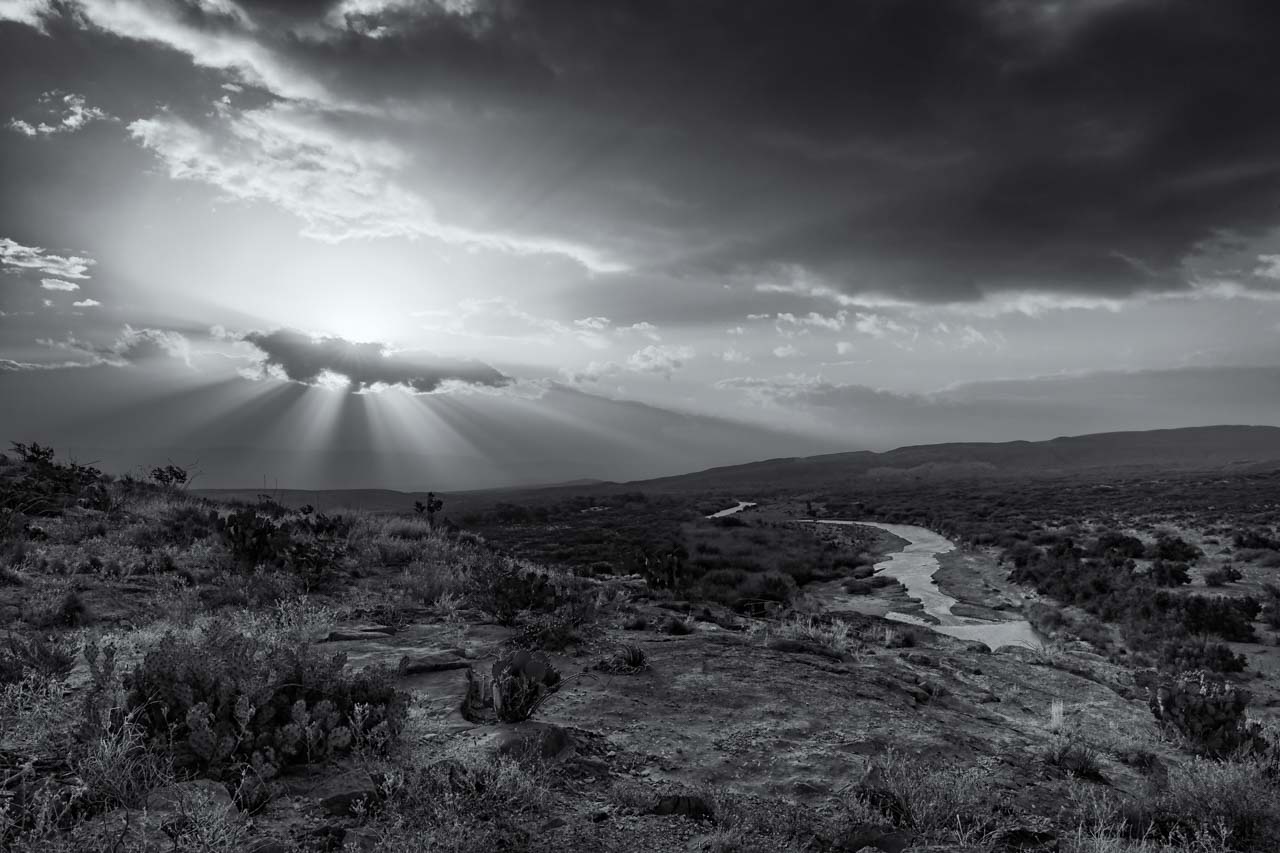
Some Essential Rules for Telling a Story with a Photo

Landscapes are perfect scenes to suggest emotions and questioning. Landscape in southern Texas along the Rio Grande.

Some Basic Rules for Building a Photo Story

The photograph that will be produced will not necessarily be technically perfect. It could, for example, be noisy. It might miss a bit of crispness or sharpness on some parts. A photograph may be imperfect, but the moment of its impact is very strong on the public. Technique is nothing compared to emotional power.

I believe that once all the photographic rules have been acquired, it is important to forget them, sometimes, to create an original photograph. It is interesting for a photographer to create his own rules from the moment the realized picture has impact. For example, I often make photos with centered points of interests. I often do not respect the rule of thirds.

The technique must be at the service of the photographer. In no case should it guide his gaze and his emotions. Technique is not necessarily a priority. Primarily, the photographer must be moved by the scene. Then, he uses the technique to convey his vision of the scene. Framing, composing, using black and white, or color, and using all the elements of the reinforcement of the reading must help to create photos with strong impacts on the audience.

Framing must be varied. The photographer must focus on whether he is taking the scene vertically or horizontally. The most interesting photograph will be retained during the editing phase. In the heat of the action, it is not always easy to see and check the best framing using the viewfinder or the control screen. It is better to take many pictures and delete the less interesting ones later.

The angles of view must be varied. The photographer must use techniques of low angle, bird’s eye view, or at the same level of the subject. For example, in wildlife photography, the pictures with the most impact are those where the eyes of the animal are at the height of the lens. Just as for framing, the best shot will be retained at the time of the editing on the computer. Shooting at a low angle makes the animal dominant to the viewers. An angle of view at the same level as the animal’s eyes implies adoption or equality to the viewers.

By varying the framing and angles of view of the photographs, a wide variety of potential images are produced. It is for this reason that the technique must be instinctive. I often tell the participants of my workshops that the technique is the "third arm of the photographer". It is instinctively used without realizing that it is actually present.

Also, the photographer must vary his compositions. For westerners who write from left to right, the sense of reading from left to right induces notions of escape, imagination or progression. A sense of reading from right to left for a westerner induces regression, confinement, introspection. The photographer must not forget that the sense of reading causes the transmission of messages in a different way.

I advise photographers not to use the technique of compositing. It means adding elements in a scene to make it truer. I think that you should stay in the photographic field and not go into the “photographism” which is another artistic discipline.

In the case of an artistic photography, it is interesting to create a picture with a lot of poetry that enables the audience to dreaming and equip their imagination. The bokeh technique is a real plus in this case.

Once on the field, whatever the place, I always advise the photographers to soak up the atmosphere of the location. This is true in landscape, underwater, or wildlife photography. Nature has a particularity to always release extraordinary odors. The morning or evening shaving lights create contrasts and lights that give the photographed scenes a rare dimension which normal daylight does not provide. The more a photographer is in fusion with the scene he is to photograph, the more his photos will be expressive. This is because the scene will be saturated in the magic moment “where all is one”.

Soaking up the ambiance of the scene or the place to photograph also requires the photographer to keep all of his senses alert. The emotional sensation of fusion is not sufficient. The photographer must look, listen, touch, and feel all of the natural elements that are facing his lens.

Often, a photo session is not enough to capture all the nuances of a scene. A photographer needs persistence and must come back often in order to more fully capture the entirety of the scene. And even then, it will never be enough. In my case for example, I sometimes go back ten times to the same location to capture different shades of light. I even return at different seasons for photo projects that last for longer durations of time. Therefore, the end result might be hundreds of pictures of the same subject or scene, yet at different times, capturing different moments. It is at the time of editing that the choice of the best photos will be made.

Last but not least, I often advise that a photographer must learn patience to create pictures with great narrative power. This is true in both wildlife photography and landscape photography. Persistence and tenacity is not always sufficient. Indeed, at each return to a given location, the photographer may have to wait hours before the perfect moment to push the trigger of the camera.

Patience and tenacity are the two greatest qualities of photographers who wish to tell beautiful photographic stories.

All of the tips I have covered so far are essential to creating a narrative, high-impact photo. Nevertheless, I often reinforce my photos with a technique known as "photo report".

What, When, Where and Why?

  1. Why and How Telling a Story through A Photo
  2. 3 Steps for Realizing a Good Photo Editing
  3. 5 Steps to Create Interesting Photos
  4. November 2016. Landscape Photo Project in Bryce Canyon, Utah

Page 115 of 201

  • 110
  • 111
  • 112
  • 113
  • 114
  • 115
  • 116
  • 117
  • 118
  • 119
  1. You are here:  
  2. Home
  3. Blog Photographic Approach

Share on Social Media

Post
Share
Share
E-mail
WhatsApp
Text

Join Me on Social Networks

Join Me on Facebook  Join Me on Instagram  Join Me on LinkedIn

Claim your free guide to make your photo impactful and meaningful

Claim Your Free Guide '50 Pages of Tips to Give Impact and Meaning to Your Photos'.

4 + 8 =

Click Here To Discover All My Chronicles About the Photographic Approach.

Treat Yourself to a Fine Art Print That Matches your Personality

Example of a vacation home interior with a black and white fine photo art displayed on the wall.

Fine Art Print Collections in Black and White

Fine Art Print Collections in Black and White Black and white photography is a suitable technique for many nature scenes. It requires a particular frame of mind. A black and white photograph should be prepared and planned from the framing to the…
11996
Fine Art Print Collections in Black and White
An abstract art photo displayed in a contemporary living room decor.

Fine Art Print Collections in Color

Collections of Fine Art Prints in Color Color photographs allow digressions and take the audience to the message by secondary ways. The world around us, especially nature, is colorful. A color image can show the way our surroundings really are. Of course, it…
10442
Fine Art Print Collections in Color
Example of a home interior with fine art prints in my style back to black displayed on the wall. These photos are a part of my collection 'Wild beauties of Kenya'.

Fine Art Print Collections in Back to Black

Fine Art Print Collections in Back to Black I want to share my fine art prints of nature in a personal style that I call "back to black." "Back to Black" was developed to embody a sharp and clean style for artistic photos that can be hung in your living room,…
9982
Fine Art Print Collections in Back to Black
A waiting room with a photo in the style Fusion displayed on the wall. Grey Heron in Fusion.

Fine Art Print Collections with the Fusion Style

Fine Art Print Collections with the Fusion Style I would like to share a very creative and modern photography style to represent Nature in a very different way. I call it "Fusion." I created the style to offer dynamic photos, allowing you to start a good day…
7914
Fine Art Print Collections with the Fusion Style
A living room with a photo in the style 'Impression' exposed on the wall. Rising sun in impression

Fine Art Print Collections with the ‘Impression’ Style

Fine Art Print Collections with the ‘Impression’ Style The objective of this photographic style is to create the ephemeral blurs. That's why I named it 'Impression.' Photography, as an art form, is a powerful means of expressing reality from different…
5828
Fine Art Print Collections with the ‘Impression’ Style
Fine art prints from the style back to black displayed on a wall. Amar Guillen, photographer artist

New Collections of Fine Art Prints Dedicated to the Wonders of Nature

New and Updated Fine Art Print Collections Dedicated to the Wonders of Nature Fine art prints from the style back to black displayed on a wall.
11448
New Collections of Fine Art Prints Dedicated to the Wonders of Nature

Themes of the Blog Articles

Landscape of Arches National Park in Utah in black and white.

Blog Articles Dedicated to Artist Statement

Blog Articles Dedicated to Artist Statement
Dunes of death Valley in Black and White

Blog Articles Dedicated to Black and White Photography

Blog Articles Dedicated to Black and White Photography
Abstract photo or trees reflection on water

Blog Articles Dedicated to Photographic Mindset

Blog Articles Dedicated to Photographic Mindset
Abstract photo of ridles on water

Blog Articles Dedicated to Artistic Photography

Blog Articles Dedicated to Artistic Photography
Abstract photo of Yellowstone

Blog Articles Dedicated to Photographic Language

Blog Articles Dedicated to Photographic Language
Pronghorn in Yellowstone

Blog Articles Dedicated to Wildlife Photography

Blog Articles Dedicated to Wildlife Photography
Landscape of Bryce Canyon

Blog Articles Dedicated to Photographing United States

Blog Articles Dedicated to Photographing United States
Underwater waves in the Red Sea

Blog Articles Dedicated to Photographic Techniques

Blog Articles Dedicated to Photographic Techniques
Tree of Black Canyon in Black and White

Blog Articles Dedicated to Landscape Photography

Blog Articles Dedicated to Landscape Photography
Manta Ray in Maldives in Black and White

Blog Articles Dedicated to Underwater Photography

Blog Articles Dedicated to Underwater Photography
Red Deer stag during the rut of the deer

Blog Articles Dedicated to Photographic Judgement

Blog Articles Dedicated to Photographic Judgement
Great Crested Greb and his chick

Unclassified Blog Articles

Unclassified Blog Articles

You Might Be Interested By One of These Photographic Approach Articles

Landscape in black and white of the Sand Dunes in Death Valley. Photograph by Amar Guillen, photographer artist.

15 Steps to Improve Your Photos

3448
15 Steps to Improve Your Photos
Coyote in the snow in Yellowstone in winter.. Photograph in color by Amar Guillen, artist photographer.

Six Tips for Managing the Criticism of Your Photos Well

3106
Six Tips for Managing the Criticism of Your Photos Well
Landscapes are perfect scenes to suggest emotions and questioning. Landscape in southern Texas along the Rio Grande.

Some Essential Rules for Telling a Story with a Photo

5993
Some Essential Rules for Telling a Story with a Photo
The magic of conceptual photography. A photo from the 'Illusions' art prints collection.

Why and How: Developing a Photographic Consciousness

3707
Why and How: Developing a Photographic Consciousness

Receive Free Tips On How to Give Impact and Meaning to Your Photos. Subscribe to Receive Regular Articles.

2 + 7 =

Contact Me By Email

10 + 9 =
This site is protected by reCAPTCHA and the Google Privacy Policy and Terms of Service apply.

About Amar Guillen, Creator of Fine Art Prints of Nature
As a photographer capturing the artistic essence for several decades, I have mastered the art of crafting an authentic experience for art enthusiasts and collectors of visual art.
When I observe my surroundings, be it friends, family, relationships, or professional contacts, I see souls in perpetual motion. Every moment of their existence is engulfed by daily hassles, work concerns, social media, online or televised information streams, and videos on the web.
Every minute, they strive to accomplish something, fearing losing ground and feeling marginalized in this frenzied society. Imprisoned by an oppressive schedule, the essential eludes them, drowned in the tumult of daily life. Is it really crucial to watch yet another cat video on the internet? Is it necessary to post twenty daily messages on social media?
Despite this, they remain constantly stressed and anxious about the challenges of the world, without being able to influence these monumental problems. It is at this moment that my artistic nature photographs come into play. Those who have had the privilege of hanging one of my works in their personal or professional space have expressed a radical transformation in their lives.
Every day, contemplating these works of art immerses them in tranquility, inner peace, and rediscovered serenity. They then understand that nature has the power to unravel tensions, to encourage reflection on the essential. Artistic photographs thus become open windows to the wonders of nature.
I have chosen to share the best of myself by helping others discover their identity, personality, style, all while reconnecting with nature. Take the time to explore my artistic photographs if you wish to reveal your true essence. Once hung in your space, your view of the world will be transformed.
Amar Guillen is a creator of fine art prints of nature.
I am Amar Guillen, creator of nature art photographs. I have a deep conviction that contemplating nature has the power to transform human beings. If everyone learned to know, respect, and preserve nature, our world would be transformed into a haven of peace where everyone would find their place.
Copyright © 2003 - 2026 Guillen Photo LLC - All rights reserved. Amar Guillen, professional photographer since 2003.
  • Blog
  • Calibration
  • Legal Information
  • Sitemap
  • Accessibility
  • Contact Me
  • Updates of the Website
I Want to Help You to Create Interesting Photos

How Can I Help You To Create More Interesting Photos?

Ask Me a Technical Question.
Subscribe to my Newsletter. The Inspiration Behind Guillen Photo.

Select your language

  • English (United Kingdom)
  • Français (France)
Claim your free guide to make your photo impactful and meaningful

Claim Your Free Guide '50 Pages of Tips to Give Impact and Meaning to Your Photos'.

3 + 2 =

Contact Me By Email

10 + 4 =

Office Address:
3512 Robin Road
Plano Texas 75075
USA

Office phone: (+1)214-769-6825