• The Art of ChoosingHome page
  • Fine Art Prints3 Editions
  • CollectionsAll Collections
  • AboutAmar Guillen
  • Customer Space & Contact
  • Select your language

    • English (United Kingdom)
    • Français (France)
  • All You Need to Select Your Fine Art Print
    • How to Choose a Fine Art Print - Q&A - FAQ
    • New Creations
    • Explore Some Interiors
    • Fine Art Print Blog
  • Browse by Edition
    • All Fine Art Prints
    • Unique Edition
    • Limited Edition
    • Open Edition
  • Browse by Style
    • Black and White
    • Color
    • Fusion
    • Impression
    • Back to Black
    • Landscapes in Black and White
    • Landscapes in Color
    • Animals in Black and White
    • Animals in Color
  • Browse by Theme
    • Landscape
    • Wildlife
    • Underwater
    • Abstract
    • Symbolic
    • Landscapes of the United States
    • Landscapes of France
    • Landscapes of Scotland
    • Seascapes
    • Relaxing
    • Energizing
    • Playful
  • Browse by Format
    • Rectangular
    • Square
    • Panoramic
  • Contact Me
    • Contact Me by Email or Phone
  • Collections
    • New Collections
    • All Collections
  • Browse by Theme
    • Landscapes
    • Wildlife
    • Underwater
    • Abstract
    • Symbolic
    • Landscapes of France
    • Landscapes of the United States
  • Browse by Style
    • Black and White
    • Color
    • Impression
    • Back to Black
    • Fusion
  • Contact Me
    • Contact Me by Email or Phone
  • Discover More About Me
    • Discover Who is Amar Guillen
    • Artistic and Photographic Statement
  • Galleries
    • Photo Galleries
    • Abstract Portfolio in Color
    • Black and White Landscape Photography Portfolio
    • Color Landscape Photography Portfolio
    • Black and White Wildlife Photography Portfolio
    • Color Wildlife Photography Portfolio
    • Underwater Photography Portfolio
  • Contact Me
    • Contact Me by Email or Phone
  • Your Customer Space
    • Create or Manage your Account
    • Your Download Space
    • Your Orders
  • Contact Me
    • Contact Me by Email or Phone

You are in that section: Home > Blog > Blog of the Photographic Creation Approach

9 Steps for Creating a Photo With a Computer and Specific Software

Sand dunes of Great Sand Dunes in the state of Colorado in United-States. Photo in black and white by Amar Guillen.
Sand dunes of Great Sand Dunes in the state of Colorado in United-States.

Definition of the Verb "To Create"

If you look up the definition of the verb "create" in the dictionary, you will find several definitions.

The most common definition is :

To create is to make or design something.

But there is another definition that is much more interesting for us who are photographers:

To create is to make original works that bear the mark of one's feelings, one's thoughts, and one's personality.

Don't you think that these few words perfectly describe the state of mind of artists in general?

Application to Photography

If I apply this definition to photography, I can say that creating a photo is to make an original image that bears the mark of your feelings, your thoughts, and your personality.

Isn't that the exact purpose of using your camera?

In any case, as far as I am concerned, this is exactly the goal I am looking for in my photographic activity.

The Creation of a Photo Requires the Use of a Computer

For me, the creation phase of a photo involves the use of software on a computer. You can also use a tablet or a cell phone with specific editing applications. The principle remains the same.

However, I choose to process my work on a computer because I believe it is the tool on par with lasting results of excellence.

Some people will argue that this is totally false. They will say that a photo can be created perfectly using only a camera without ever processing on a computer.

I agree with these arguments for some photos that are simply perfect from the start. However, the percentage of these successful photos seems about 0.01%. Even if we were to be generous and say that 0.05% of all photos taken do not need processing, this is still a slim number.

Personally, I usually only manage to capture 2 ideal photos at the time of shooting. It is very few compared to the 1300 photos which constitute my stock of developed photos.

Nowadays when I take pictures in the field, in other words, when I build them, I make sure they

  • are well exposed,
  • are well contrasted,
  • contain the right amount of sharpness,
  • manage colors well,
  • incorporate visible creativity,
  • are well composed,
  • are well framed.

When I photograph a scene, I make several images. In landscape photography, I change my point of view in height or by moving from side to side. Sometimes a move of 1 meter produces a spectacular result.

In European wildlife photography, as I am often on the prowl, I cannot move. I always assess the potential of the scene before I advance.

In African or American wildlife photography, animals are often less fearful than those in Europe, because they are less hunted. In this case, I can afford to change my point of view.

Regardless, when I fire up my camera, I always try to make sure that my photo has potential. I will elaborate on this concept in a later paragraph.

Despite all these precautions and all this setting up, my photos on the ground are generally rather flat and without relief. The colors are bland. I must also specify that I often use natural light.

In underwater photography, the use of 2 flashes allows me to obtain generous colors and particularly good contrasts. But this type of photographic practice remains rather confidential and little practiced by photographers.

That is why I use a computer and software to develop my photos. This is what I call the creation phase of a photograph.

Why and How: Judging a Photograph.

The Purpose of Developing a Photo

As I have just explained, the creation of a photo involves its development. Except for rare expressions, this is a necessary phase with photos taken in RAW.

I often explain it during my workshops and conferences: developing a photo allows you to reinforce your photographic process and your artistic process if you have one.

You remember that in one of the definitions of the verb to create, there is the word personality and the word feeling. To create is to put your own stamp on it. To create is to differentiate yourself from other photographers or other artists. To achieve this, the development of your photos is the surest and most certain way.

Developing a photograph allows you to best express that you have to say by reinforcing the image you have built in the field.

The Steps to Create a Photo

In this paragraph, I place myself in the case of the creation of a natural photo. By this I mean that I do not mention montage photos.

  • The first step for me is always reframing. This is an essential step because often a good crop gives a different vision and impact. SLR cameras have sensors with proportions 3:2 or 4:3 (Olympus). In many cases this ratio is not adapted. Personally, I like the rectangular 16:9, 2:1, or 3:1 ratio, and the square 1:1 ratio. I often adopt standard formats because for framing or adding a mat, it is easier to find the right products.
  • The second step is noise removal. I often shoot in low light. My photos are often noisy. I have a loss of quality in the rendering of details. Denoising with a specialized software allows me to recover those details.
  • The third step is the management of distortion. I apply profiles to correct the distortion and chromatic aberration induced by my photo lenses.
  • The fourth step is to remove disruptive elements.
  • The fifth step is to manage the sharpness. It is essential, especially if you use long focal lengths. I take particular care to make the essential points of a photo sharp. For example, for an animal, I want the focal points to rest in the eyes.
  • If the photo I want to create is in color, the sixth step is to manage the color contrasts. The knowledge of the color wheel is essential to manage the complementary colors. My goal is to attract the attention of the viewer.
  • If the photo I want to create is in black and white, the sixth step is to transform my photo into shades of gray.
  • The next step is to manage the contrast of my photo. I use only different dodge and bun techniques. I paint each part of my photo to find the best contrast.
  • At this point, I have in front of me a corrected photo that is sharp, well cropped, well exposed, well contrasted, and has been noise reduced. The photo is harmonious, easy to look at, and simple to understand. So far, I have only applied general technical tools, and already it is a better version than its previous self.
  • Now, and this is the eighth step, I will apply my personal style to create an atmosphere to my photo. I will enhance the atmosphere. For this crucial step, I will use filters, brushes, and gradient techniques. This stage is certainly the most important for me. It is at this moment that my creativity will express itself. It is difficult and quite long.
  • Finally, and this is the ninth step, I finish my photo by scanning it with the zoom at 100% to correct the small defects. It is in this finishing step that I add the vignetting.

The Evaluation of the Potential of a Photo

A Beautiful Encounter with a Red Deer Stag During Bugle Season

Have you ever had the chance to observe a deer in its natural environment during the bugle season?

I lived this story during the month of September 2021. The slab had just begun. This encounter with a wild solitary red deer stag lasted several minutes. It was 4 minutes of complete happiness and intense joy. It happened in the western France.

I have been photographing the red deer stag's bugle every year for the past 10 years. It is a season that I look forward to with great anticipation and excitement. These intense moments that I experienced will remain forever engraved in my memory.

Besides sharing this interesting story, my main purpose of this article is to also show you that the fixed blind is certainly the best way to capture unique and intriguing wildlife photos of mammals in Europe.

Red deer stage during the rut of the deer. Photograph in black and white by Amar Guillen, artist photographer.
I only kept this photo of my encounter with this deer during the slab. It is the most accurate to illustrate what I felt.

The Story

September 2021. It is 6 o'clock in the morning. The night is dark. I know the terrain well, as I have been scouting it for two days. I have been walking for 15 minutes through the woods. My goal is to reach a meadow which is a well-known spot for bugling.

The night is quiet. I hear a few deer bugling in the distance. But no deer are bugling yet at the place where I am headed towards.

The closer I get to the place, the more I slow down my pace so as not to be heard. I want to blend in against the foliage of the ancient and peaceful oaks. Under my feet I sometimes feel an acorn. I sometimes step from side to side so as to avoid a branch or pile of leaves. There is no question-I must not alert a potential buck or worse, a doe. At night, even if these deer are able to see shapes, it is mainly their hearing that is on alert. They can detect an unusual noise at more than 900 feet (300 meters). At the slightest sound will easily startle. I have already experienced this.

They do not always run away if they hear a peculiar sound, but they remain alert. They keep a close eye on the area where the noise was detected. If they see a human form, they immediately flee to a safer place.

If it is a herd, the spotter will give the signal by barking. The leader doe will do the rest by leading the herd in the direction she has chosen. If it is a single deer, he will run away without a sound.

I finally reach the edge of the woods. The meadow is in front of me. I hear absolutely no noise. The night is peaceful. An owl hooted in the distance. Maybe there was a deer that ran away. I will never know. Too bad. I will set up my blind and wait.

Stalking for long hours is a true pleasure for me. I can hear the daytime world slowly awakening. I discover the chirping birds. I admire the spider webs built during the night and shining when the sun rises. Contemplating nature is an extraordinarily relaxing act. I forget everything. The noise of men is forgotten for a few hours. If you have ever experienced these magical moments, you certainly know what I mean. If you have never experienced these sensations, try to settle in the forest on a foggy morning. You will understand the wonder that I feel.

For this blind, I chose to set up in a bramble towards the edge of the clearing, with my back facing the direction in which the sun will rise. I am downwind. The temperature is around 46 degrees Fahrenheit (8 degrees Celsius). Under my camouflage hood, I can feel the cool wind rushing in. I am well covered. At this time of year, I wear gloves. I also use the three-layer system for my clothes. I am prepared for several hours of waiting.

The sun will rise behind me. Conditions are optimal. With a headwind from the west, the animals will not smell me. With the sun at my back, they will not see me easily. I have been waiting three days for all these elements to come together. I am impatient. I hope that a deer deigns to make an appearance.

When I choose a blind, I know the location has potential. In this case, I know that this meadow is a bugling site. I have already had the opportunity to observe with a pair of binoculars a herd with a nice buck and a few does. I know that satellite deer are trying to conquer some females by snatching them from the herd master. It is a beautiful sight.

I most often use a blind tent with a chair. This time, I chose a cloth photo blind. I wanted to be equipped light. Indeed, the tent is quite heavy. The walk was long. I did not want to embarrass myself. I really like the cover flap. It allows me to have a wider angle of view than my small tent. I lose comfort, but I am more versatile.

I set up my seat, my tripod. I set up my camera. My lens is a 500 mm. I always have an SLR camera. I use an anti-noise mitt to reduce the sound emitted at the time of the release. Even with this accessory and even if I use the silent mode of my camera, the deer still detect my presence because of the noise. Mirrorless cameras are a real breakthrough because they do not make any noise. At the time of writing this tree, Nikon still has not released a mirrorless camera that is on par with its competitors.

Next, I put my cloth photo blind in place. I chose the summer model. In the morning, it lets the cold through, but at this time of year, when the sun comes up, the temperature becomes quite pleasant. If I used my winter clothe blind, the temperature would be difficult to bear in the middle of the morning.

After a few minutes of preparation, I crawl under my cloth photo blind. I sit down. My seat is not as comfortable as the one attached to my tent. It has no backrest. But I do not regret this choice. I will have more leeway if a deer makes an appearance in the meadow.

Why and How: Photographing the Bugle of Deer using a Cloth Photo Blind.

It is 6:25 in the morning. The night is still dark. There is no moon. The waiting begins. I scan the meadow through the net. I try to see a shape. But apparently no deer are present today. I will wait. Patience is a quality of any wildlife photographer.

What can you do when you are in a blind? The answer is simple: wait and think. The minutes and the hours pass slowly. One can easily count each second during this time of waiting. It requires great patience.

It is 8:15 a.m. The day is breaking. The first rays of sunlight appear. The meadow is empty. I thought I saw a red deer stag was coming on my right. But I was wrong. There is nothing.

9:02 am. I take my time. The lights are still beautiful, but no deer are present. I decide to stay another hour before putting my things away.

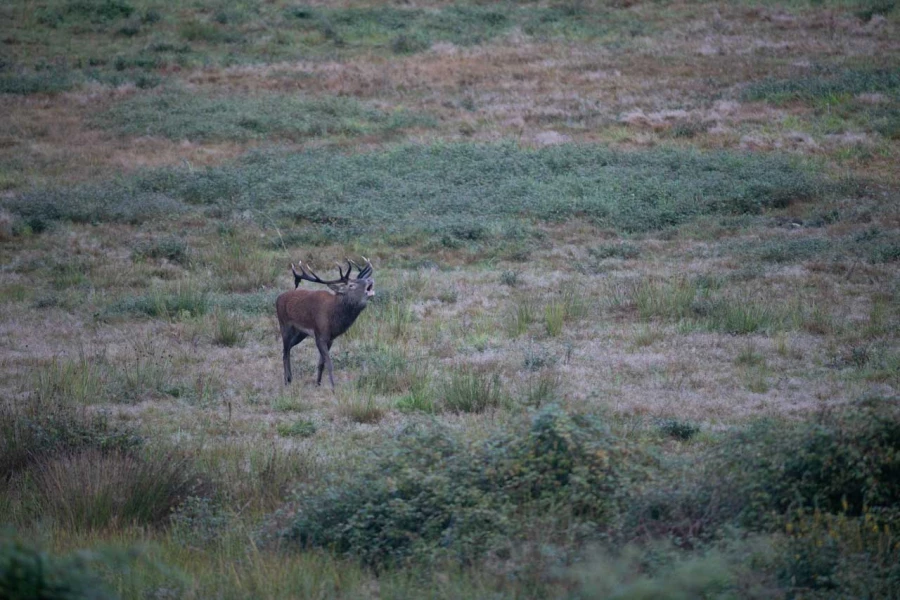
Suddenly, down and to the left of the meadow, I hear a deer bugling. I am a little numb from the early morning chill, but the cry gives me hope. I feel my senses are on alert. I put my eye against the eyepiece of my camera. The deer is about 450 feet (150 meters) to my left. It is downhill. He is very badly positioned. He is sheepish. He moves forward slowly, bugling as he steps. I am a little disappointed because I did not expect it at this place. Despite everything, I take some pictures. I let off steam and try not to be annoyed that after all of this time, this creature comes to me from a direction I least expected.

I tell myself that with a bit of luck, he will come towards me or go to my right. He will then be at my level. Maybe I will get a good picture. Hope is life.

6 Steps to Define a Good Photo.

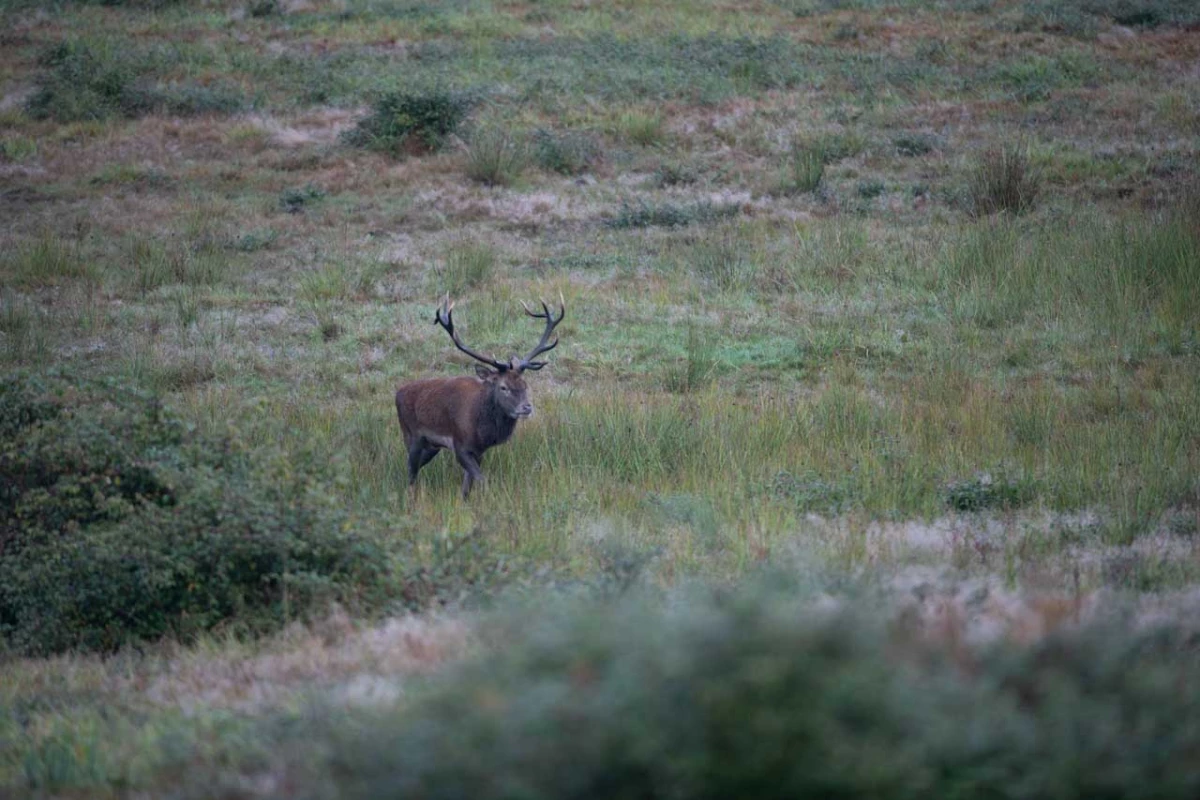
He is still moving. He has a 16-point rack. He is magnificent. I do not understand why such a buck did not manage to conquer the hearts of a few does. He must have encountered youngsters, who are more valiant, quick, and agile in battle. I begin to realize that he is heading towards me. It is incredible. I am so excited. I also realize that I have not chosen my place well. I have brambles in my field of vision. I never thought it would have appeared on my left. I had placed everything on my right.

He keeps coming. He is handsome. His head is down. I trigger the shutter two or three times. Soon, he occupies a good part of my viewfinder. I do not dare raise my head, because I do not want to startle my woodland ghost. The sight of deer is very sharp. The slightest suspicious movement can make them run away.

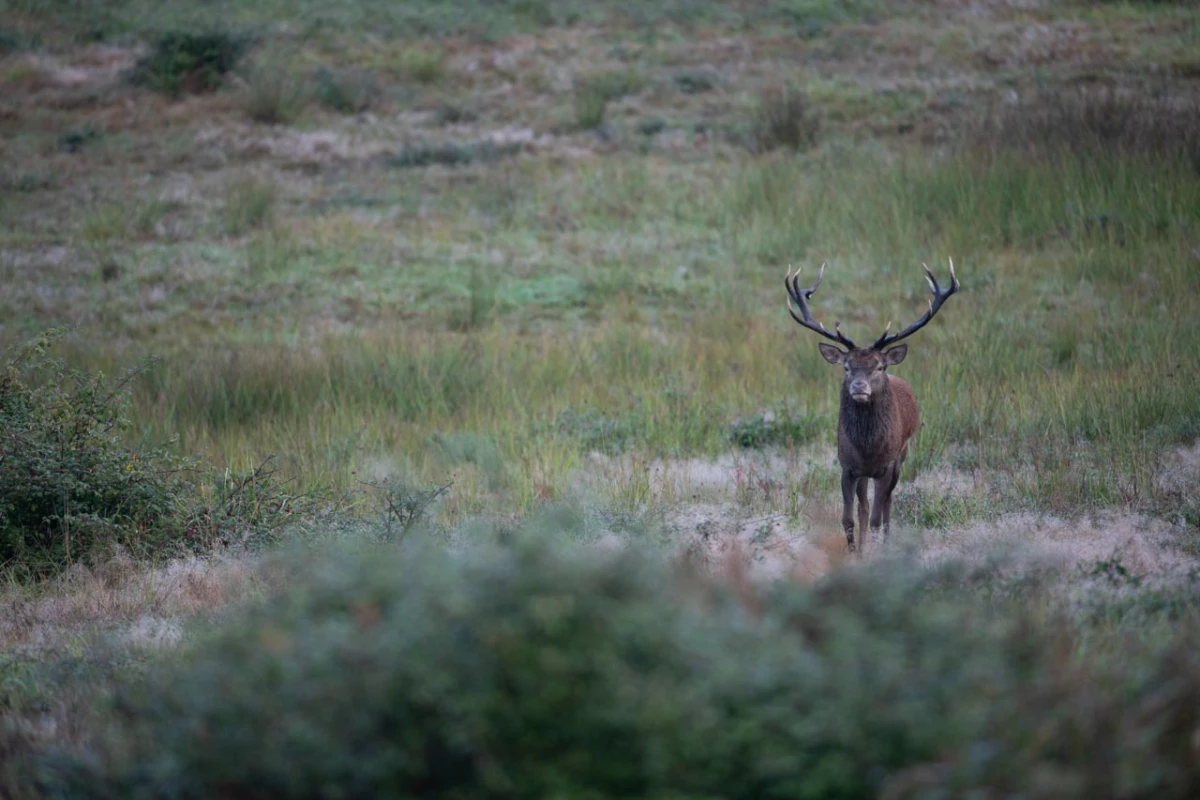
He must be within 75 feet (25 meters). I take a first photo, holding my breath. And quickly realize that he has heard the sound of the camera. He is raising his head. His ears are pointed in my direction. He is on full alert. I wait a few seconds to trigger it. I do not want him to run away.

His 16 points are incredible. He is proud, elegant, and powerful. He stares at me. He does not know what he is dealing with. Deer have an excellent photographic memory. They know how to spot something unusual in their environment. He looks at me. I wait. We stay more than a minute, our gazes locking together. He and I can both be patient.

There is no need for me to go off. He has just got a bramble behind him. The picture will not be interesting. Suddenly, he decides to step to his right. I move my camera slightly. This movement does not escape him. He is really tense and worried. I realize that the area in the background is now clear. There are no more brambles. So much for the noise. I trigger twice. The noise and the previous movement have really made him wary. He decides to leave.

He is gone. He is out of my sight. And I have only two pictures. But what incredible pictures they are. It is rare that I take pictures from so close with my 500mm. The encounter lasted 4 minutes. The intensity was strong. I feel my heart beating fast. I am so happy.

The following pictures show the sequence from the moment of the first bellow to the final picture. They are from my camera. They are raw film.

The last picture is the one I selected and developed.

  • 01 cerf bois sec pendant le brame
    01 cerf bois sec pendant le brame
  • 03 cerf bois sec pendant le brame
    03 cerf bois sec pendant le brame
  • 04 cerf bois sec pendant le brame
    04 cerf bois sec pendant le brame
  • 05 cerf bois sec pendant le brame
    05 cerf bois sec pendant le brame
  • 06 cerf bois sec pendant le brame
    06 cerf bois sec pendant le brame
  • 07 cerf bois sec pendant le brame
    07 cerf bois sec pendant le brame
  • 08 cerf bois sec pendant le brame
    08 cerf bois sec pendant le brame
  • 09 cerf bois sec pendant le brame
    09 cerf bois sec pendant le brame
  • 10 cerf bois sec pendant le brame
    10 cerf bois sec pendant le brame
  • 11 cerf bois sec pendant le brame
    11 cerf bois sec pendant le brame
  • 12 cerf bois sec pendant le brame
    12 cerf bois sec pendant le brame
  • 13 cerf bois sec pendant le brame
    13 cerf bois sec pendant le brame
  • 14 cerf bois sec pendant le brame
    14 cerf bois sec pendant le brame
  • 15 cerf bois sec pendant le brame
    15 cerf bois sec pendant le brame
  • 16 cerf bois sec pendant le brame
    16 cerf bois sec pendant le brame
  • 17 cerf bois sec pendant le brame
    17 cerf bois sec pendant le brame
  • 18 cerf bois sec pendant le brame
    18 cerf bois sec pendant le brame
  • 19 cerf bois sec pendant le brame
    19 cerf bois sec pendant le brame
  • 20 cerf bois sec pendant le brame
    20 cerf bois sec pendant le brame
  • 21 cerf bois sec pendant le brame
    21 cerf bois sec pendant le brame
  • 22 cerf bois sec pendant le brame
    22 cerf bois sec pendant le brame
01 cerf bois sec pendant le brame
03 cerf bois sec pendant le brame
04 cerf bois sec pendant le brame
05 cerf bois sec pendant le brame
06 cerf bois sec pendant le brame
07 cerf bois sec pendant le brame
08 cerf bois sec pendant le brame
09 cerf bois sec pendant le brame
10 cerf bois sec pendant le brame
11 cerf bois sec pendant le brame
12 cerf bois sec pendant le brame
13 cerf bois sec pendant le brame
14 cerf bois sec pendant le brame
15 cerf bois sec pendant le brame
16 cerf bois sec pendant le brame
17 cerf bois sec pendant le brame
18 cerf bois sec pendant le brame
19 cerf bois sec pendant le brame
20 cerf bois sec pendant le brame
21 cerf bois sec pendant le brame
22 cerf bois sec pendant le brame
    • 01 cerf bois sec pendant le brame
    • 03 cerf bois sec pendant le brame
    • 04 cerf bois sec pendant le brame
    • 05 cerf bois sec pendant le brame
    • 06 cerf bois sec pendant le brame
    • 07 cerf bois sec pendant le brame
    • 08 cerf bois sec pendant le brame
    • 09 cerf bois sec pendant le brame
    • 10 cerf bois sec pendant le brame
    • 11 cerf bois sec pendant le brame
    • 12 cerf bois sec pendant le brame
    • 13 cerf bois sec pendant le brame
    • 14 cerf bois sec pendant le brame
    • 15 cerf bois sec pendant le brame
    • 16 cerf bois sec pendant le brame
    • 17 cerf bois sec pendant le brame
    • 18 cerf bois sec pendant le brame
    • 19 cerf bois sec pendant le brame
    • 20 cerf bois sec pendant le brame
    • 21 cerf bois sec pendant le brame
    • 22 cerf bois sec pendant le brame
    1. 2 Essential Steps for Making Your Photos Interesting and Creative
    2. How to Calibrate Your Screen for Printing Without a Colorimeter
    3. Choosing the Right Paper to Print Your Digital Photos
    4. 7 Tips to Improve the Printing Process of Your Digital Photos

    Page 26 of 201

    • 21
    • 22
    • 23
    • 24
    • 25
    • 26
    • 27
    • 28
    • 29
    • 30
    1. You are here:  
    2. Home
    3. Blog Photographic Approach

    Share on Social Media

    Post
    Share
    Share
    E-mail
    WhatsApp
    Text

    Join Me on Social Networks

    Join Me on Facebook  Join Me on Instagram  Join Me on LinkedIn

    Claim your free guide to make your photo impactful and meaningful

    Claim Your Free Guide '50 Pages of Tips to Give Impact and Meaning to Your Photos'.

    4 + 8 =

    Click Here To Discover All My Chronicles About the Photographic Approach.

    Treat Yourself to a Fine Art Print That Matches your Personality

    Example of a vacation home interior with a black and white fine photo art displayed on the wall.

    Fine Art Print Collections in Black and White

    Fine Art Print Collections in Black and White Black and white photography is a suitable technique for many nature scenes. It requires a particular frame of mind. A black and white photograph should be prepared and planned from the framing to the…
    11991
    Fine Art Print Collections in Black and White
    An abstract art photo displayed in a contemporary living room decor.

    Fine Art Print Collections in Color

    Collections of Fine Art Prints in Color Color photographs allow digressions and take the audience to the message by secondary ways. The world around us, especially nature, is colorful. A color image can show the way our surroundings really are. Of course, it…
    10440
    Fine Art Print Collections in Color
    Example of a home interior with fine art prints in my style back to black displayed on the wall. These photos are a part of my collection 'Wild beauties of Kenya'.

    Fine Art Print Collections in Back to Black

    Fine Art Print Collections in Back to Black I want to share my fine art prints of nature in a personal style that I call "back to black." "Back to Black" was developed to embody a sharp and clean style for artistic photos that can be hung in your living room,…
    9980
    Fine Art Print Collections in Back to Black
    A waiting room with a photo in the style Fusion displayed on the wall. Grey Heron in Fusion.

    Fine Art Print Collections with the Fusion Style

    Fine Art Print Collections with the Fusion Style I would like to share a very creative and modern photography style to represent Nature in a very different way. I call it "Fusion." I created the style to offer dynamic photos, allowing you to start a good day…
    7908
    Fine Art Print Collections with the Fusion Style
    A living room with a photo in the style 'Impression' exposed on the wall. Rising sun in impression

    Fine Art Print Collections with the ‘Impression’ Style

    Fine Art Print Collections with the ‘Impression’ Style The objective of this photographic style is to create the ephemeral blurs. That's why I named it 'Impression.' Photography, as an art form, is a powerful means of expressing reality from different…
    5827
    Fine Art Print Collections with the ‘Impression’ Style
    Fine art prints from the style back to black displayed on a wall. Amar Guillen, photographer artist

    New Collections of Fine Art Prints Dedicated to the Wonders of Nature

    New and Updated Fine Art Print Collections Dedicated to the Wonders of Nature Fine art prints from the style back to black displayed on a wall.
    11446
    New Collections of Fine Art Prints Dedicated to the Wonders of Nature

    Themes of the Blog Articles

    Landscape of Arches National Park in Utah in black and white.

    Blog Articles Dedicated to Artist Statement

    Blog Articles Dedicated to Artist Statement
    Dunes of death Valley in Black and White

    Blog Articles Dedicated to Black and White Photography

    Blog Articles Dedicated to Black and White Photography
    Abstract photo or trees reflection on water

    Blog Articles Dedicated to Photographic Mindset

    Blog Articles Dedicated to Photographic Mindset
    Abstract photo of ridles on water

    Blog Articles Dedicated to Artistic Photography

    Blog Articles Dedicated to Artistic Photography
    Abstract photo of Yellowstone

    Blog Articles Dedicated to Photographic Language

    Blog Articles Dedicated to Photographic Language
    Pronghorn in Yellowstone

    Blog Articles Dedicated to Wildlife Photography

    Blog Articles Dedicated to Wildlife Photography
    Landscape of Bryce Canyon

    Blog Articles Dedicated to Photographing United States

    Blog Articles Dedicated to Photographing United States
    Underwater waves in the Red Sea

    Blog Articles Dedicated to Photographic Techniques

    Blog Articles Dedicated to Photographic Techniques
    Tree of Black Canyon in Black and White

    Blog Articles Dedicated to Landscape Photography

    Blog Articles Dedicated to Landscape Photography
    Manta Ray in Maldives in Black and White

    Blog Articles Dedicated to Underwater Photography

    Blog Articles Dedicated to Underwater Photography
    Red Deer stag during the rut of the deer

    Blog Articles Dedicated to Photographic Judgement

    Blog Articles Dedicated to Photographic Judgement
    Great Crested Greb and his chick

    Unclassified Blog Articles

    Unclassified Blog Articles

    You Might Be Interested By One of These Photographic Approach Articles

    Photograph in black and white of the Grand Canyon from Arizona State in USA.

    Why and How Mastering the Steps of Creating an Art Photograph

    3603
    Why and How Mastering the Steps of Creating an Art Photograph
    An example of a narrative photo. Landscape of Island in the Sky in the Canyonlands in Utah in United States. Photo in black and white by Amar Guillen.

    Why and How: Creating Impactful Narrative Photos

    4118
    Why and How: Creating Impactful Narrative Photos
    Snowy landscape of Yellowstone during winter.

    3 Steps for Giving Meaning to Your Photos

    8750
    3 Steps for Giving Meaning to Your Photos
    Two lions in Kenya. Photographed in black and white. Photograph by Amar Guillen, photographer artist.

    To Create Aesthetics Photos, Print your Images

    4238
    To Create Aesthetics Photos, Print your Images

    Receive Free Tips On How to Give Impact and Meaning to Your Photos. Subscribe to Receive Regular Articles.

    2 + 7 =

    Contact Me By Email

    10 + 9 =
    This site is protected by reCAPTCHA and the Google Privacy Policy and Terms of Service apply.

    About Amar Guillen, Creator of Fine Art Prints of Nature
    As a photographer capturing the artistic essence for several decades, I have mastered the art of crafting an authentic experience for art enthusiasts and collectors of visual art.
    When I observe my surroundings, be it friends, family, relationships, or professional contacts, I see souls in perpetual motion. Every moment of their existence is engulfed by daily hassles, work concerns, social media, online or televised information streams, and videos on the web.
    Every minute, they strive to accomplish something, fearing losing ground and feeling marginalized in this frenzied society. Imprisoned by an oppressive schedule, the essential eludes them, drowned in the tumult of daily life. Is it really crucial to watch yet another cat video on the internet? Is it necessary to post twenty daily messages on social media?
    Despite this, they remain constantly stressed and anxious about the challenges of the world, without being able to influence these monumental problems. It is at this moment that my artistic nature photographs come into play. Those who have had the privilege of hanging one of my works in their personal or professional space have expressed a radical transformation in their lives.
    Every day, contemplating these works of art immerses them in tranquility, inner peace, and rediscovered serenity. They then understand that nature has the power to unravel tensions, to encourage reflection on the essential. Artistic photographs thus become open windows to the wonders of nature.
    I have chosen to share the best of myself by helping others discover their identity, personality, style, all while reconnecting with nature. Take the time to explore my artistic photographs if you wish to reveal your true essence. Once hung in your space, your view of the world will be transformed.
    Amar Guillen is a creator of fine art prints of nature.
    I am Amar Guillen, creator of nature art photographs. I have a deep conviction that contemplating nature has the power to transform human beings. If everyone learned to know, respect, and preserve nature, our world would be transformed into a haven of peace where everyone would find their place.
    Copyright © 2003 - 2026 Guillen Photo LLC - All rights reserved. Amar Guillen, professional photographer since 2003.
    • Blog
    • Calibration
    • Legal Information
    • Sitemap
    • Accessibility
    • Contact Me
    • Updates of the Website
    I Want to Help You to Create Interesting Photos

    How Can I Help You To Create More Interesting Photos?

    Ask Me a Technical Question.
    Subscribe to my Newsletter. The Inspiration Behind Guillen Photo.

    Select your language

    • English (United Kingdom)
    • Français (France)
    Claim your free guide to make your photo impactful and meaningful

    Claim Your Free Guide '50 Pages of Tips to Give Impact and Meaning to Your Photos'.

    4 + 8 =

    Contact Me By Email

    9 + 2 =

    Office Address:
    3512 Robin Road
    Plano Texas 75075
    USA

    Office phone: (+1)214-769-6825