• The Art of ChoosingHome page
  • Fine Art Prints3 Editions
  • CollectionsAll Collections
  • AboutAmar Guillen
  • Customer Space & Contact
  • Select your language

    • English (United Kingdom)
    • Français (France)
  • All You Need to Select Your Fine Art Print
    • How to Choose a Fine Art Print - Q&A - FAQ
    • New Creations
    • Explore Some Interiors
    • Fine Art Print Blog
  • Browse by Edition
    • All Fine Art Prints
    • Unique Edition
    • Limited Edition
    • Open Edition
  • Browse by Style
    • Black and White
    • Color
    • Fusion
    • Impression
    • Back to Black
    • Landscapes in Black and White
    • Landscapes in Color
    • Animals in Black and White
    • Animals in Color
  • Browse by Theme
    • Landscape
    • Wildlife
    • Underwater
    • Abstract
    • Symbolic
    • Landscapes of the United States
    • Landscapes of France
    • Landscapes of Scotland
    • Seascapes
    • Relaxing
    • Energizing
    • Playful
  • Browse by Format
    • Rectangular
    • Square
    • Panoramic
  • Contact Me
    • Contact Me by Email or Phone
  • Collections
    • New Collections
    • All Collections
  • Browse by Theme
    • Landscapes
    • Wildlife
    • Underwater
    • Abstract
    • Symbolic
    • Landscapes of France
    • Landscapes of the United States
  • Browse by Style
    • Black and White
    • Color
    • Impression
    • Back to Black
    • Fusion
  • Contact Me
    • Contact Me by Email or Phone
  • Discover More About Me
    • Discover Who is Amar Guillen
    • Artistic and Photographic Statement
  • Galleries
    • Photo Galleries
    • Abstract Portfolio in Color
    • Black and White Landscape Photography Portfolio
    • Color Landscape Photography Portfolio
    • Black and White Wildlife Photography Portfolio
    • Color Wildlife Photography Portfolio
    • Underwater Photography Portfolio
  • Contact Me
    • Contact Me by Email or Phone
  • Your Customer Space
    • Create or Manage your Account
    • Your Download Space
    • Your Orders
  • Contact Me
    • Contact Me by Email or Phone

You are in that section: Home > Blog > Blog of the Photographic Creation Approach

Why and How: Photographing Canyon de Chelly In Arizona

If you have the opportunity to travel to the southwestern region of the United States to photograph the mineral landscapes, I highly suggest that you spend some time in the Canyon de Chelly in the state of Arizona.

The pictures you will take of the absolutely beautiful mineral landscapes will enchant your friends and family when you return home.

In this article, I will explain why photographing the Canyon de Chelly is not as easy as it seems. I will also share some tips on how to create interesting pictures that are different from the previous photos you have already taken.
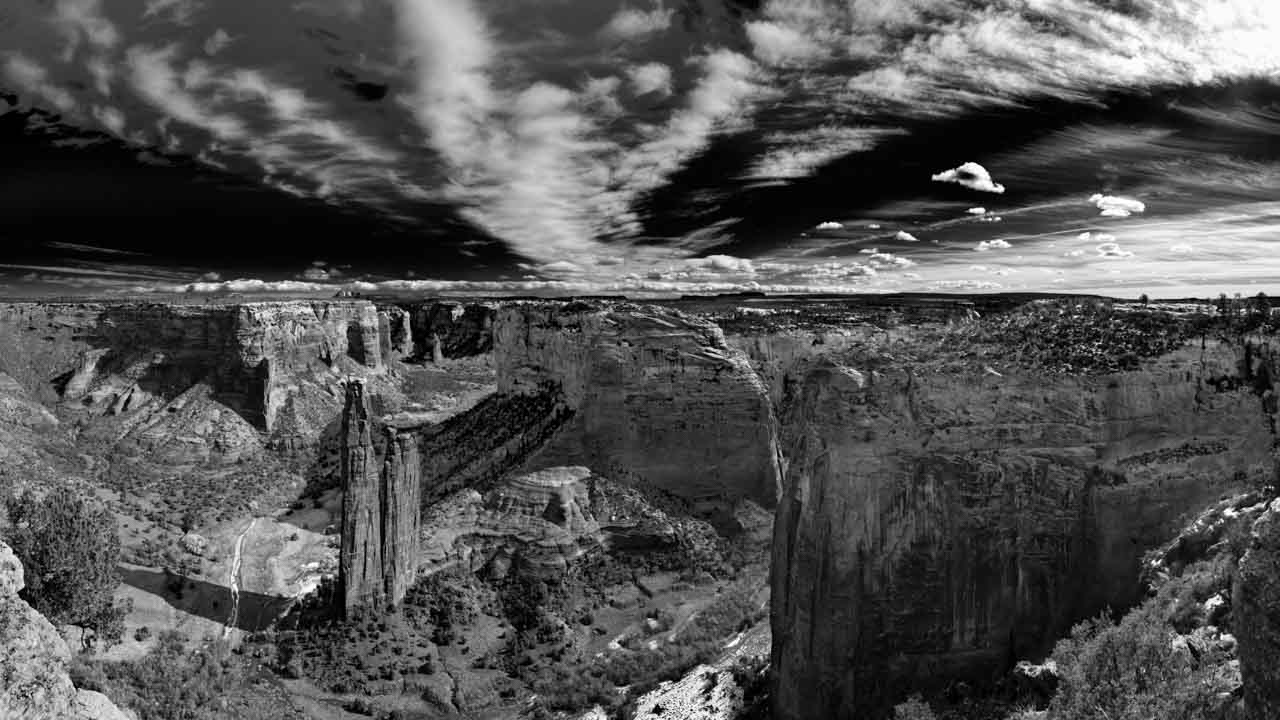
Spider Rock in Canyon de Chelly in Arizona in black and white. Photography by Amar Guillen, Photographer Artist
Spider Rock in Canyon de Chelly in Arizona.

Table of Contents

  • The Little Story Behind This Article
  • A Few Words About the Canyon de Chelly
  • Photographing the Canyon de Chelly
  • Some Pictures of Canyon de Chelly
  • Framing the Canyon de Chelly
  • The Interpretation of Canyon de Chelly

The Little Story Behind This Article

I photographed the Canyon de Chelly for the first time in 2010. I had stopped in the city of Chinle to spend a night on the road while travelling the Grand Canyon.

While talking with the hotel receptionist, I learned that he was from the Navajo tribe. I explained to him that I was a professional photographer and that I was conducting a large photographic project on the National Parks of the United States.

He told me about his family who lived in Chelly Canyon. In English, it should be pronounced Canyon de Chai. When he realized that I knew nothing about this iconic site, he invited me to discover it the following day by joining him on an adventure aboard his four-wheel drive vehicle.

It was a real shock. The canyon is more than 25 miles long (40 kilometers). The cliffs are more than 980 feet high (300 meters). But the aspect that left me the most stunned is certainly the orange color of the rocks. The history of the place is haunting as well. He told me the story of the Navajos who arrived in the 18th century and how they were massacred by Spanish colonists in 1805.

I spent the day with him and his family. It was an incredible experience. I visited the canyon with a private guide. I later learned that visiting the canyon is forbidden if you are not accompanied by a guide. Thus, luck was on my side.

During this first trip, I spent 3 days creating photographs. Since then, I regularly spend at least 3 nights in Chinle to try to capture the extraordinary lights of the Canyon de Chelly. I often came back without having taken a single photo because the lights I desired were simply not present. It is a challenge for sure.

A Few Words About the Canyon de Chelly

As I mentioned in a previous paragraph, Canyon de Chelly is a huge private property. It belongs to the Navajo tribe. If you want to visit the canyon, you must hire a guide. I advise that you hire a private guide. There are group tours, but the quality is quite poor.

This is a national American moment. It was established in 1931.

The word Chelly comes from the Navajo word 'Tseyi' which means canyon, literally meaning 'inside the rock'.

Today, more than forty families live in the canyon. They grow corn and raise cows and horses.

Photographing the Canyon de Chelly

Like most canyons, most of the photos you will capture will be taken from the rims. You will thus have a view of the horizon as well as the interior of the canyon.

The landscapes are absolutely spectacular because they are textured with magnificent orange colors. The details and contrast are extraordinary for a landscape photographer.

Inevitably, you will likely decide to use color for your shots. Most of the photographers I know do this in a way, as it highlights the natural vibrant beauty.

The only problem with using color is that you are going to take photographs that have already been taken thousands of times. All you have to do is search on the internet with the keywords "Canyon de Chelly photographs" to realize that most of the famous images are in color.

Now search with the keywords "black and white photographs of Canyon de Chelly". The choice will be much more restricted.

Personally, I think that black and white allows the photographer to show the beauty of the canyon as well as all its subtleties and nuances.

To carry out this photo project, I was inspired by Edward S. Curtis and Ansel Adams who created photos that I find quite beautiful. I followed in their footsteps to express the similar emotions that I experienced when I contemplated Spider Rock or White House.

The use of black and white allows you, the photographer, to present a more personal perspective of the magnificence and majesty of the canyon.

The main difficulty is to photograph the canyon with a distant horizon. Often, the sky is blue without any clouds. I have participated in several sessions during the last few years in which I have not been able to make a single artistic photo due to the lack of clouds and desired light conditions.

Sometimes I was lucky. Patience paid off. But I spent countless hours waiting for the right light and beautiful clouds.

I often say that clouds are the language of the sky. If they are not present in the picture, it is not possible to speak the photographic language, because the forms of the clouds are so important for communicating emotions and meanings.

Read Also: Why and How: Photographing Valley of Fire in Nevada.

Some Pictures of Canyon de Chelly

Click on a thumbnail to enlarge it.

  • Photo of Canyon de Chelly in Arizona in black and white.
    Photo of Canyon de Chelly in Arizona in black and white.
    Photo of Canyon de Chelly in Arizona in black and white.
  • Photo of Canyon de Chelly in Arizona in black and white.
    Photo of Canyon de Chelly in Arizona in black and white.
    Photo of Canyon de Chelly in Arizona in black and white.
  • Photo of Canyon de Chelly in Arizona in black and white.
    Photo of Canyon de Chelly in Arizona in black and white.
    Photo of Canyon de Chelly in Arizona in black and white.
  • Photo of Canyon de Chelly in Arizona in black and white.
    Photo of Canyon de Chelly in Arizona in black and white.
    Photo of Canyon de Chelly in Arizona in black and white.
  • Photo of Canyon de Chelly in Arizona in black and white.
    Photo of Canyon de Chelly in Arizona in black and white.
    Photo of Canyon de Chelly in Arizona in black and white.
  • Photo of Canyon de Chelly in Arizona in black and white.
    Photo of Canyon de Chelly in Arizona in black and white.
    Photo of Canyon de Chelly in Arizona in black and white.
  • Photo of Canyon de Chelly in Arizona in black and white.
    Photo of Canyon de Chelly in Arizona in black and white.
    Photo of Canyon de Chelly in Arizona in black and white.
  • Photo of Canyon de Chelly in Arizona in black and white.
    Photo of Canyon de Chelly in Arizona in black and white.
    Photo of Canyon de Chelly in Arizona in black and white.
Photo of Canyon de Chelly in Arizona in black and white.
    • Photo of Canyon de Chelly in Arizona in black and white.
    • Photo of Canyon de Chelly in Arizona in black and white.
    • Photo of Canyon de Chelly in Arizona in black and white.
    • Photo of Canyon de Chelly in Arizona in black and white.
    • Photo of Canyon de Chelly in Arizona in black and white.
    • Photo of Canyon de Chelly in Arizona in black and white.
    • Photo of Canyon de Chelly in Arizona in black and white.
    • Photo of Canyon de Chelly in Arizona in black and white.
    Read Also: Why and How: Photographing Landscapes in Black and White.

    Framing the Canyon de Chelly

    When framing and formatting photos of the Canyon de Chelly, anything is possible. Whether it is a 3:2 horizontal format or square format, or vertical format, all are relevant and can be utilized depending on your personal preference.

    The Canyon de Chelly is a true source of inspiration. Let yourself contemplate how the Navajo people live their simple lives. This simplicity may help you to capture the quintessence of the region.

    The main difficulty is the management of shadows. Since it is a canyon, you will have to wait for the light to penetrate inside to reveal the shapes. If you photograph early in the morning or late in the evening, you will have gigantic and unsightly shadows. You will have created great imbalances in the masses within your frame.

    I believe that the ideal time to photograph is mid-morning or mid-afternoon. I advise you to spend a day looking for lights depending on the location. For example, to photograph Spider Rock, the ideal is in the morning because the shade is beautiful.

    The Interpretation of Canyon de Chelly

    For me, Canyon de Chelly reminds me of families who lived in the shadow of the past. The lifestyle of the people who live there is based off tradition, it is timeless.

    Indeed, when you visit this special place, time will have seemed to have stopped. You will notice that the landscape provides much “food for thought” and contemplation. The first day of each of my trips is devoted to the search for light, waiting, and introspection. I took a few freehand pictures to immerse myself in the atmosphere. I know that I will have to be patient like my predecessors and my masters Curtis and Adams were.

    I recommend that you immerse yourself in the history of the Navajo and Pueblo people before you visit this site to better understand and appreciate those who live in the Chelly Canyon. Their fascinating stories, traditions, and rich history will help you to find inspiration to create unique photos.
    Click Here To See Black and White Fine Art Print Collections.

    5 Rules to Judge a Photo Subjectively

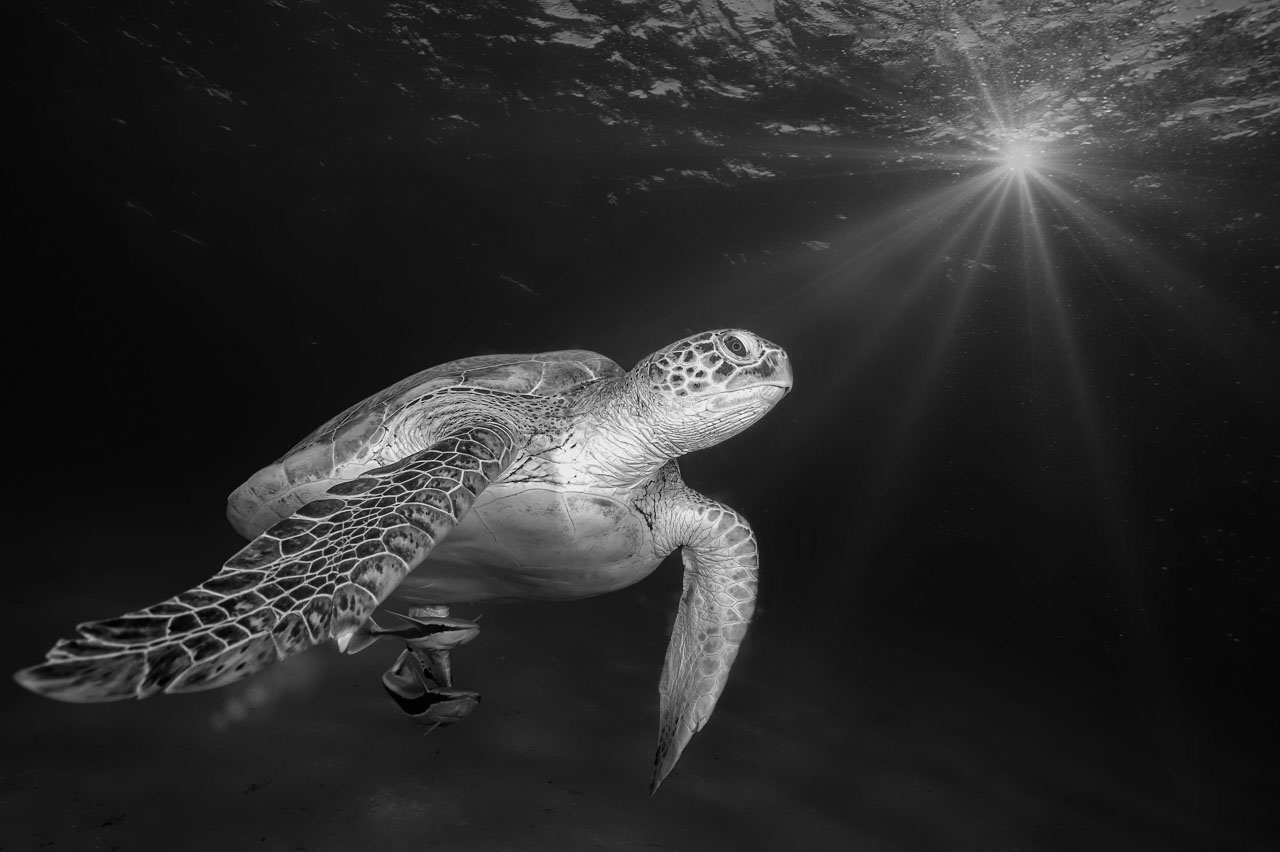
    Turtle swimming in the Red Sea in black and white. Photograph by Amar Guillen, photographer artist.
    Turtle swimming in the Red Sea. Peacefulness, tranquility, and elegance characterize this black and white underwater photo.

    How Judging Subjectively?

    You certainly think that to judge photographs, whether your own or those of others, all you have to do is say what goes through your mind without any filter.

    I think that would be a mistake.

    Judging subjectively requires discernment.

    Avoid snap judgments. All judgements must be justified, argued in a valid and above all constructive manner.

    Especially if they are pictures of other photographers. Think that your arguments can hurt, harm. You need to motivate them and take shape in what you are going to say.

    Judging subjectively means that you will do it according to yourself, your experiences, your life experience. Judging subjectively requires restraint, good manners.

    You must not do it with resentment.

    Suppose you know one or another photographer. But you do not appreciate him or her as a person because his or her values and morals do not match yours.

    When you judge her or his photographs, you need to step back and forget your feelings about her or him!

    You must only judge the photos. You should appeal only to your photographic emotions and not to what you think of the person. These are two totally different things.

    When I explain this principle during my workshops, I always take the example of the writer Louis-Ferdinand Céline. He wrote one of the best novels I have ever read "Voyage au bout de la nuit". And yet, his attitude during the Second World War was shameful and contrary to all values. And yet I appreciate the book.

    I think it is important to separate the work from the author.

    When you judge subjectively, only speak about your emotions and what you feel about the pictures you are looking at.

    Use your general knowledge and experience.

    Pretend you do not know the author of the photographs. Remain neutral.

    State simple, understandable, and justified criteria.

    Even if your reasoning is imperfect, no one will hold it against you if you speak sincerely, elegantly, without offending anyone.

    I have listened to people criticizing photographers before who were acting in bad faith. They did not use objective criteria like my 10 criteria. The criteria were clearly subjective because they were based on experience. But clearly, it was bad faith. I will not go into detail because that would give too much importance to this small circle of people who are given too much importance.

    The advice I would like to give you is to judge subjectively but sincerely without trying to impress the gallery with false arguments.

    That will make you more credible.

    To sum up, I think that in order to judge subjectively, certain rules of conduct must be observed, which involve :

    • Decency.
    • Benevolencee.
    • Respect.
    • Good faith.
    • Elegance in the words.
    Read also: Why and How Defining a Good Photograph.

    Subjective Judgment Is Not Enough

    Do not think that because you are going to judge with your emotions, your experiences and your life experience, your soul, you will judge well.

    That would be a mistake.

    Judging subjectively is well suited to choosing a photo to hang in your living or working place. It is normal that you make a subjective choice because you will contemplate the photo for an exceptionally long time. It should correspond to you as much as possible.

    But let us imagine you are with friends and you are discussing a photographer's photographic approach or about a collection of photos.

    It is normal to give a subjective opinion on photos to create or participate in a debate. But you will not be able to tell if the photos are good or not.

    To do this, you must adopt an objective criteria grid. Finally, whether you use objective or subjective judgment on photographs depends entirely on the circumstances in which you do so.

    Read Also: Why It Is So Difficult to Judge a Fine Art Photograph.

    Subjective Judgment Is Always Present

    I had the opportunity to participate as a judge in many photo competitions.

    Whenever I was on the jury, I always had a presentation of all the photos before we got together to judge.

    Fatally, I have always had favorites that corresponded to my personal tastes. I like ethereal, minimalist atmospheres. I like photos that are easy to read and that evoke freedom and solitude.

    When the photos are scrolled one by one in front of the jury to give a grade, it is obvious that my emotions immediately come back to the surface of my mind after the overall visualization with the jury.

    Yet I try to ignore it. I try to be as objective as possible. I use the verb 'to try', voluntarily. I know in my heart of hearts whether or not I like pictures.

    Perhaps my subjective judgment slightly alters my objective judgment. I do not have proof of that. But after all these years I do not think there is anything anyone can do about it.

    Objectivity in judgement is always balanced by subjectivity.

    It is certainly for this reason that different juries will classify identical photos in different ways.

    Finally

    I hope that this new article on photographic judging will have opened your mind on how to judge photos subjectively.

    Always try to be as moral and ethical as possible in your judgments.

    When you use subjective criteria, be elegant, good faith and argue without ulterior motives.

    Appeal to your emotions, to your experiences.

    Put aside your negative feelings.

    Above all, do not deprive yourself of subjective judgment. It is one more string to your bow to make even more interesting and creative photos.

    Be humble, patient, constant, persevering, and persistent because the road to excellence is long.

    1. Why and How Judging a Photograph Subjectively
    2. Why and How: Photographing the Valley of Fire in Nevada
    3. A Good Photo Should Tell a Story and Generate Interest
    4. 6 Steps to Define a Good Photo

    Page 44 of 201

    • 39
    • 40
    • 41
    • 42
    • 43
    • 44
    • 45
    • 46
    • 47
    • 48
    1. You are here:  
    2. Home
    3. Blog Photographic Approach

    Share on Social Media

    Post
    Share
    Share
    E-mail
    WhatsApp
    Text

    Join Me on Social Networks

    Join Me on Facebook  Join Me on Instagram  Join Me on LinkedIn

    Claim your free guide to make your photo impactful and meaningful

    Claim Your Free Guide '50 Pages of Tips to Give Impact and Meaning to Your Photos'.

    4 + 8 =

    Click Here To Discover All My Chronicles About the Photographic Approach.

    Treat Yourself to a Fine Art Print That Matches your Personality

    Example of a vacation home interior with a black and white fine photo art displayed on the wall.

    Fine Art Print Collections in Black and White

    Fine Art Print Collections in Black and White Black and white photography is a suitable technique for many nature scenes. It requires a particular frame of mind. A black and white photograph should be prepared and planned from the framing to the…
    11991
    Fine Art Print Collections in Black and White
    An abstract art photo displayed in a contemporary living room decor.

    Fine Art Print Collections in Color

    Collections of Fine Art Prints in Color Color photographs allow digressions and take the audience to the message by secondary ways. The world around us, especially nature, is colorful. A color image can show the way our surroundings really are. Of course, it…
    10440
    Fine Art Print Collections in Color
    Example of a home interior with fine art prints in my style back to black displayed on the wall. These photos are a part of my collection 'Wild beauties of Kenya'.

    Fine Art Print Collections in Back to Black

    Fine Art Print Collections in Back to Black I want to share my fine art prints of nature in a personal style that I call "back to black." "Back to Black" was developed to embody a sharp and clean style for artistic photos that can be hung in your living room,…
    9980
    Fine Art Print Collections in Back to Black
    A waiting room with a photo in the style Fusion displayed on the wall. Grey Heron in Fusion.

    Fine Art Print Collections with the Fusion Style

    Fine Art Print Collections with the Fusion Style I would like to share a very creative and modern photography style to represent Nature in a very different way. I call it "Fusion." I created the style to offer dynamic photos, allowing you to start a good day…
    7908
    Fine Art Print Collections with the Fusion Style
    A living room with a photo in the style 'Impression' exposed on the wall. Rising sun in impression

    Fine Art Print Collections with the ‘Impression’ Style

    Fine Art Print Collections with the ‘Impression’ Style The objective of this photographic style is to create the ephemeral blurs. That's why I named it 'Impression.' Photography, as an art form, is a powerful means of expressing reality from different…
    5827
    Fine Art Print Collections with the ‘Impression’ Style
    Fine art prints from the style back to black displayed on a wall. Amar Guillen, photographer artist

    New Collections of Fine Art Prints Dedicated to the Wonders of Nature

    New and Updated Fine Art Print Collections Dedicated to the Wonders of Nature Fine art prints from the style back to black displayed on a wall.
    11446
    New Collections of Fine Art Prints Dedicated to the Wonders of Nature

    Themes of the Blog Articles

    Landscape of Arches National Park in Utah in black and white.

    Blog Articles Dedicated to Artist Statement

    Blog Articles Dedicated to Artist Statement
    Dunes of death Valley in Black and White

    Blog Articles Dedicated to Black and White Photography

    Blog Articles Dedicated to Black and White Photography
    Abstract photo or trees reflection on water

    Blog Articles Dedicated to Photographic Mindset

    Blog Articles Dedicated to Photographic Mindset
    Abstract photo of ridles on water

    Blog Articles Dedicated to Artistic Photography

    Blog Articles Dedicated to Artistic Photography
    Abstract photo of Yellowstone

    Blog Articles Dedicated to Photographic Language

    Blog Articles Dedicated to Photographic Language
    Pronghorn in Yellowstone

    Blog Articles Dedicated to Wildlife Photography

    Blog Articles Dedicated to Wildlife Photography
    Landscape of Bryce Canyon

    Blog Articles Dedicated to Photographing United States

    Blog Articles Dedicated to Photographing United States
    Underwater waves in the Red Sea

    Blog Articles Dedicated to Photographic Techniques

    Blog Articles Dedicated to Photographic Techniques
    Tree of Black Canyon in Black and White

    Blog Articles Dedicated to Landscape Photography

    Blog Articles Dedicated to Landscape Photography
    Manta Ray in Maldives in Black and White

    Blog Articles Dedicated to Underwater Photography

    Blog Articles Dedicated to Underwater Photography
    Red Deer stag during the rut of the deer

    Blog Articles Dedicated to Photographic Judgement

    Blog Articles Dedicated to Photographic Judgement
    Great Crested Greb and his chick

    Unclassified Blog Articles

    Unclassified Blog Articles

    You Might Be Interested By One of These Photographic Approach Articles

    Photograph in black and white of the Grand Canyon from Arizona State in USA.

    Why and How Mastering the Steps of Creating an Art Photograph

    3603
    Why and How Mastering the Steps of Creating an Art Photograph
    An example of a narrative photo. Landscape of Island in the Sky in the Canyonlands in Utah in United States. Photo in black and white by Amar Guillen.

    Why and How: Creating Impactful Narrative Photos

    4118
    Why and How: Creating Impactful Narrative Photos
    Snowy landscape of Yellowstone during winter.

    3 Steps for Giving Meaning to Your Photos

    8750
    3 Steps for Giving Meaning to Your Photos
    Two lions in Kenya. Photographed in black and white. Photograph by Amar Guillen, photographer artist.

    To Create Aesthetics Photos, Print your Images

    4238
    To Create Aesthetics Photos, Print your Images

    Receive Free Tips On How to Give Impact and Meaning to Your Photos. Subscribe to Receive Regular Articles.

    2 + 7 =

    Contact Me By Email

    10 + 9 =
    This site is protected by reCAPTCHA and the Google Privacy Policy and Terms of Service apply.

    About Amar Guillen, Creator of Fine Art Prints of Nature
    As a photographer capturing the artistic essence for several decades, I have mastered the art of crafting an authentic experience for art enthusiasts and collectors of visual art.
    When I observe my surroundings, be it friends, family, relationships, or professional contacts, I see souls in perpetual motion. Every moment of their existence is engulfed by daily hassles, work concerns, social media, online or televised information streams, and videos on the web.
    Every minute, they strive to accomplish something, fearing losing ground and feeling marginalized in this frenzied society. Imprisoned by an oppressive schedule, the essential eludes them, drowned in the tumult of daily life. Is it really crucial to watch yet another cat video on the internet? Is it necessary to post twenty daily messages on social media?
    Despite this, they remain constantly stressed and anxious about the challenges of the world, without being able to influence these monumental problems. It is at this moment that my artistic nature photographs come into play. Those who have had the privilege of hanging one of my works in their personal or professional space have expressed a radical transformation in their lives.
    Every day, contemplating these works of art immerses them in tranquility, inner peace, and rediscovered serenity. They then understand that nature has the power to unravel tensions, to encourage reflection on the essential. Artistic photographs thus become open windows to the wonders of nature.
    I have chosen to share the best of myself by helping others discover their identity, personality, style, all while reconnecting with nature. Take the time to explore my artistic photographs if you wish to reveal your true essence. Once hung in your space, your view of the world will be transformed.
    Amar Guillen is a creator of fine art prints of nature.
    I am Amar Guillen, creator of nature art photographs. I have a deep conviction that contemplating nature has the power to transform human beings. If everyone learned to know, respect, and preserve nature, our world would be transformed into a haven of peace where everyone would find their place.
    Copyright © 2003 - 2026 Guillen Photo LLC - All rights reserved. Amar Guillen, professional photographer since 2003.
    • Blog
    • Calibration
    • Legal Information
    • Sitemap
    • Accessibility
    • Contact Me
    • Updates of the Website
    I Want to Help You to Create Interesting Photos

    How Can I Help You To Create More Interesting Photos?

    Ask Me a Technical Question.
    Subscribe to my Newsletter. The Inspiration Behind Guillen Photo.

    Select your language

    • English (United Kingdom)
    • Français (France)
    Claim your free guide to make your photo impactful and meaningful

    Claim Your Free Guide '50 Pages of Tips to Give Impact and Meaning to Your Photos'.

    1 + 1 =

    Contact Me By Email

    10 + 2 =

    Office Address:
    3512 Robin Road
    Plano Texas 75075
    USA

    Office phone: (+1)214-769-6825