• The Art of ChoosingHome page
  • Fine Art Prints3 Editions
  • CollectionsAll Collections
  • AboutAmar Guillen
  • Customer Space & Contact
  • Select your language

    • English (United Kingdom)
    • Français (France)
  • All You Need to Select Your Fine Art Print
    • How to Choose a Fine Art Print - Q&A - FAQ
    • New Creations
    • Explore Some Interiors
    • Fine Art Print Blog
  • Browse by Edition
    • All Fine Art Prints
    • Unique Edition
    • Limited Edition
    • Open Edition
  • Browse by Style
    • Black and White
    • Color
    • Fusion
    • Impression
    • Back to Black
    • Landscapes in Black and White
    • Landscapes in Color
    • Animals in Black and White
    • Animals in Color
  • Browse by Theme
    • Landscape
    • Wildlife
    • Underwater
    • Abstract
    • Symbolic
    • Landscapes of the United States
    • Landscapes of France
    • Landscapes of Scotland
    • Seascapes
    • Relaxing
    • Energizing
    • Playful
  • Browse by Format
    • Rectangular
    • Square
    • Panoramic
  • Contact Me
    • Contact Me by Email or Phone
  • Collections
    • New Collections
    • All Collections
  • Browse by Theme
    • Landscapes
    • Wildlife
    • Underwater
    • Abstract
    • Symbolic
    • Landscapes of France
    • Landscapes of the United States
  • Browse by Style
    • Black and White
    • Color
    • Impression
    • Back to Black
    • Fusion
  • Contact Me
    • Contact Me by Email or Phone
  • Discover More About Me
    • Discover Who is Amar Guillen
    • Artistic and Photographic Statement
  • Galleries
    • Photo Galleries
    • Abstract Portfolio in Color
    • Black and White Landscape Photography Portfolio
    • Color Landscape Photography Portfolio
    • Black and White Wildlife Photography Portfolio
    • Color Wildlife Photography Portfolio
    • Underwater Photography Portfolio
  • Contact Me
    • Contact Me by Email or Phone
  • Your Customer Space
    • Create or Manage your Account
    • Your Download Space
    • Your Orders
  • Contact Me
    • Contact Me by Email or Phone

You are in that section: Home > Blog > Blog of the Photographic Creation Approach

15 Steps to Improve Your Photos

Do you want to truly improve the quality of your nature photographs by making them more interesting and creative?

Do you want to go above and beyond in making beautiful postcards?

If so, you are like me.

In this article, I offer 15 tips that I apply for each of my fine art print collections.

Take your time when reading this article because I am revealing the very essence of photography.

Landscape in black and white of the Sand Dunes in Death Valley. Photograph by Amar Guillen, photographer artist.
Landscape in black and white from the South Rim of the Grand Canyon in Arizona.

Table of Contents

    Page 1

  • The Little Story Behind This Article
  • Revisiting the Necessary Points for Judging a Photo
  • TDLSC: The Essential Rule for Creating a Nature Photograph
  • Page 2

  • Tip #1: Creating Photos That Look Like You
  • Tip #2: Perfectly Mastering the Technique
  • Tip #3: Seek Inspiration
  • Tip #4: Create Images That Produce an Emotional Impact
  • Tip #5: Create Images Based off Your Experiences
  • Tip #6: Expanding Beyond Illustrative Images
  • Tip #7: Photographing Iconic Scenes with a Single Idea
  • Page 3

  • Tip #8: Look at Nature in a Different Way
  • Tip #9: Create Photos for Yourself
  • Tip #10: Imagine your Photos Before Shooting
  • Tip #11: Be Simple
  • Tip #12: Finding a Mentor
  • Tip #13: Tell Stories
  • Tip #14: Choose Two or Three Photo Themes
  • Tip #15: Practice
  • Finally

The Little Story Behind This Article

It was the month of February. The temperatures were quite pleasant in Arizona. I left our studio in Texas for three weeks to create new photographs for my master photo project. For three days, I hiked the Valley of the Gods. I had only met two people since the start of my journey.

Whenever I begin working on new photos for any personal project, I experience extraordinary energy. Before embarking on my trip, I had visited dozens of websites which discussed the Valley of the Gods and read several books on this amazing place. I felt prepared and inspired on that first day of the journey. As I held my camera in my hands, I felt a thrill of energy at the prospect of this new project.

I decided to set a goal for myself of capturing six black and white photographs.

For three days, I drove between the buttes with my off-road vehicle. I had not yet managed to create a single photo. The sky was perfectly blue. The light was beautiful in the middle of the morning and in the middle of the afternoon. However, there was not a single cloud.

The presence of clouds was important because I needed them to help portray my own emotions. I needed the clouds to accentuate the drama and majesty of my scenes. I needed the clouds to provide intense scenes with multiple planes to create layers of depth. The clouds would allow me to accentuate the details of these marvelous mineral landscapes.

Sadly, I realized that the clouds I wanted would not appear that first day. then, the depression announced did not happen. I would have to wait until the next day. I was depressed, and I was not sure how to best utilize my time as I waited for the end of the day to draw near.

At that moment, I was sitting on a rock. My picnic was ready, and I began to mentally list the essential points of create interesting photos.

Suddenly, the following tips began to circulate in my mind, as if they were a mantra. After repetitively thinking of the same points, I grasped my voice recorder which is always at my side. It is my reminder to capture my thoughts when they appear. I spoke out loud. A squirrel waiting for me to give him a few crumbs from my meal gazed up at me. He must have really thought that human beings are a strange species.

If he knew the importance of everything I said, he would consider me differently.

The rest of this article is a summary of all these points that I apply in my photo projects.

Revisiting the Necessary Points for Judging a Photo

There are 10 points you must always remember when judging your photos.

You can use this method as a central application or as an alternative to your own method for judging images.

I advise you to print this list and always have it with you. With time invested in practice, you will think of them automatically.

  • Impact
  • Cretivity
  • Style
  • Composition
  • Centers of interest
  • Light.
  • Management of color.
  • Story.
  • Technique.
Read also: How to Judge a Photograph and Why.

TDLSC: The Essential Rule for Creating a Nature Photograph

When you create a picture of nature, you must always keep in mind the five following essential points. This is what I call the TDLSC rule.

The following paragraphs discuss this rule in further detail.

Timing

The first letter of ' T ' stands for timing.

You must always choose the right moment to shoot and take your photo. For an animal photo, it can be a behavior or an attitude.

In underwater photo, it can be the position of a fish, or an underwater mammal.

In landscape photography, it can be a light that will highlight a mineral structure, vegetal textures, or a reflection.

Timing also refers to the specific time of the year in which you are creating the photo project when the weather is favorable.

In wildlife photography, timing refers to when an event occurs.

In landscape photography, it refers to when a phenomenon, such as the northern lights, is most active.

In underwater photography, it may refer to the season of coral spawning.

I believe that in photography, everything involves the question of timing. There may be certain times that are better than others to take interesting photos. Be curious.

Before going to the field for a photo project or a photo session, be sure that luck is on your side by researching and choosing to photograph in the time that best suits your photographic situation.

Decor

The letter of 'D' stands for the decor.

This is the second point of my rule. The decor is especially important for the construction of your photographs. Without decor, there are no good photos.

You may ask yourself, “Well then, what is an appropriate décor?” Ultimately, appropriate décor includes the objects and scenery that carry your photographic elements and enhance them.

The decor must have a balance of masses, it must use the “creepage”, that is, the gradual movement of lines of convergence, etc. This is what I explain in my article on how to use photographic language.

Never forget that the decor is like a situation where you showcase your main subject.

Take an analogy of a piece of jewelry, for example. You may choose to give a piece of jewelry to a special person in your life. The packaging will most likely reveal the brand. Next, the jewelry case will entice the person who is receiving the gift. They have not yet seen the jewel, and yet, they are flooded with excitement and are alert to what will happen next, the revelation of a breathtaking gem or intricate metal design. They are “triggered” with excitement by the packaging and case, and they have not even seen the piece yet.

A good nature photograph accomplishes the exact same result. The décor will entice your audience's appetite so that the viewers will want to analyze your photograph.

Light

'L' concerns the light.

This is the third-most important point that you must consider. Whether in landscape photography, underwater photography, or wildlife photography, light creates the dynamics, the relief, and the depth of your nature photographs. It is what establishes depth to your images. In this case, I am talking about natural light.

Personally, I prefer side lighting because it allows me to create shadows that generates modeling.

Subject

'S' stands for the subject.

You may be asking why I placed the subject so far down the list in my rule.

The reason is simple. It is not that important. For example, in abstract conceptual photographs, it is the atmosphere and the colors which are most important for the photographer to focus on.

The subject in artistic and creative photography is simply one of the many elements that will translate your emotions, feelings, and messages.

The subject acts as a support beam. It holds up the emotion that is shared in the image. It could also be used as a channel through which messages flow. However, if you place too much importance on the subject in artistic photography, then you are returning to the field of illustrative photography. Your subject will become an illustration rather than an interpretation of what you see.

Composition

'C' concerns the composition.

The composition of a nature photograph involves organizing all photographic elements of a scene in order to create a balanced and harmonious picture.

The choice of a good composition makes it possible to highlight the main photographic elements, such as the subject (s).

This way of composing was intended to create aesthetic images which are pleasant to view.

If you want to create interesting photos that make sense, then you should not solely focus on the composition. It is just one ingredient in the recipe. A good composition should allow you to place the photographic elements so that they properly express your emotions and your messages.

The elements of the photographic language that you are going to use will be developed in your composition. Be very vigilant during this step.

Remember this acronym: TDLSC. If you apply it correctly, your photographs will have that little extra “secret ingredient” that makes them stand out in comparison to with other photographers. This is how you will customize your photographic creations.
Read also: Why and How Composing A Nature Photograph Well.

Tip # 1: Creating Photos That Look Like You

Main Subject Is Essential in Wildlife Photography in Black and White

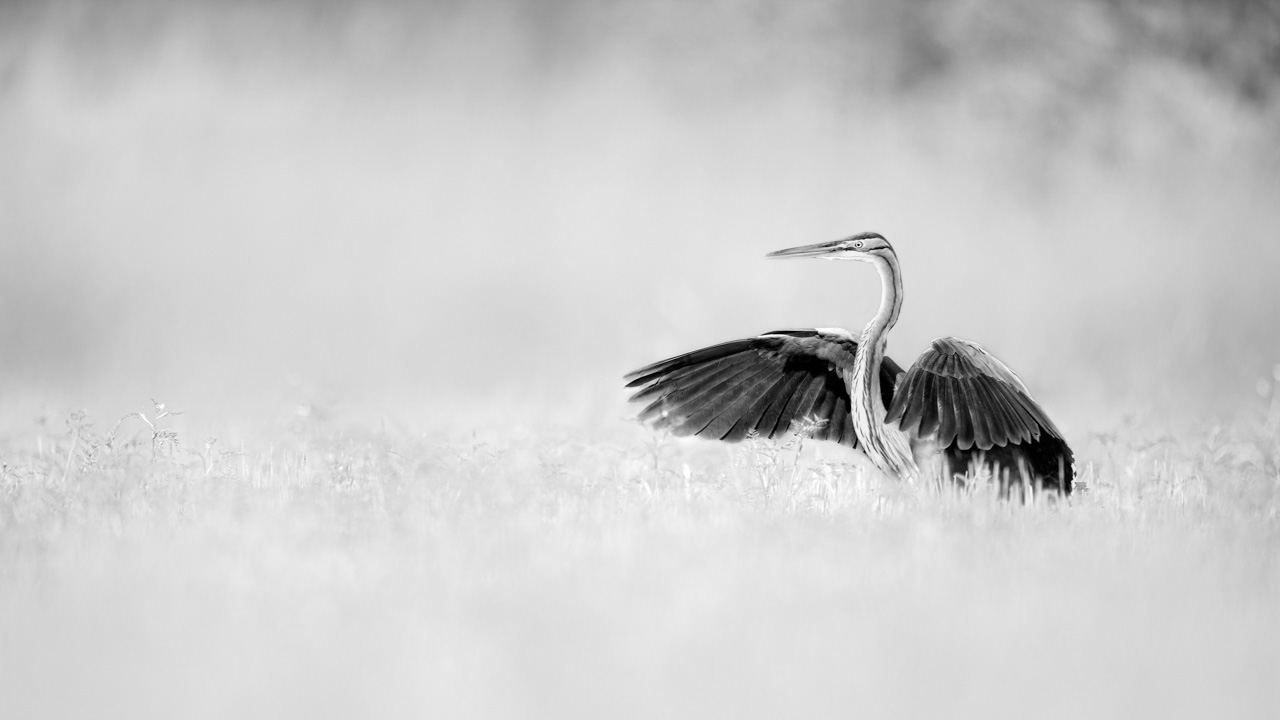
Photograph of a purple heron in black and white in la Dombes in France. Photograph by Amar Guillen, photographer artist.
Black and white is well-suited for photographs of birds, like this photo of a purple heron in La Dombes in France.

How Creating Wildlife Photographs in Black and White? (The End)

  • Cloudy skies are precious allies.

    Never forget that clouds are the language of the sky. When developing your photos on the computer, you must take special care with the clouds because they give depth to your photos.

    The main thing in black and white wildlife photography is the main subject. As the black and white is an interpretation of the scene you see, nothing prevents you to convey emotions messages. The clouds are there to help you.

    However, you will need to be careful in how you use them. They must help to highlight the animals. They are not the main photographic elements.
  • You can also use the patterns of a scene to highlight the animals. The patterns are based on repetition. In black and white, they are a precious ally. These patterns can be trees, leaves on the ground, and pebbles. The idea is to cover an area of the photo with patterns to guide the viewer's eye to the animal.
  • When you create an animal photograph, regardless of whether it is in black and white or not, you must always respect the fundamental rule of the line of sight.

    If you photograph above the line of sight, the viewer will have the impression that the meeting is artificial.

    In addition, you create a powerful relationship between you and the animal. If the gaze of the animal ends below your own gaze, you create a sense of domination. This is not what you want to show in wildlife photos.

    You may be like me and want to create a sense of respect between the animal and the viewer.

    Of course, for birds in flight, you will have trouble photographing them at eye level. But in this case, another creative technique will be used.
  • I also advise you to use the silhouette technique in black and white wildlife photography. In the gallery of images associated with this article, there are several examples. The silhouette is very symbolic because it can be evocative of many meanings. It can express a departure from reality into another world, an unspoken emotion, or private glance into the discrete life of the animal.

    To have the best possible photographic effect, the use of blacklight technique is ideal. It allows you to highlight the shapes of the animals.
  • In this paragraph devoted to how to create wildlife photos in black and white, I want to emphasize that if you use this creative technique, you must especially consider the shadows, highlights, and mid tones. When you are in the field, you can ignore the colors and their saturation. As I explained in another article, color saturation has no impact on a photo.
  • When creating animal pictures in black and white, you tell similar stories that you would tell in color, but with a different language. Black and white is more emotional and sentimental.
  • As I said in a previous paragraph, the creation of a black and white photo begins before the session, continues in the field, materializes during the development phase, and ends with the printing on paper.

    For the development phase, you will have the choice between many different computer software. My goal in this article is not to tell you which are the best and how to use them, because there are updates and changes yearly, causing a fluctuation in which is the best software.

    Nevertheless, it is beneficial if you remember the following points.

    Do not desaturate your photos to bring them to black and white.

    Use color adjustment to achieve the best rendering.

    Use the dodge and burn technique. It allows selective adjustments to be made. Use the curves to adjust the different tones.
  • The classic animal portrait is also an excellent technique for highlighting wild animals in black and white.

    In this case, I recommend the square framing. It is perfectly suited because it reinforces the development of the animal. You leave little space for the environment and the negative space. In the gallery associated with this article, you will see some examples of animal portraits.

  • The last tip on how to take black and white wildlife photos is to always create strong compositions, choose the textures well, have dynamic perspectives, and be careful when choosing your light.

Finally

In this article, I have listed many reasons for you to create black and white wildlife photographs.

It is a technique that allows you to create photos that have impact, meaning, and which accurately express your emotions and transmit your messages.

When you are on the field, experiencing this technique yourself, be sure to respect nature and animals, observe the surroundings before taking your photos, and always be aware of your compositions, perspectives, shapes, and textures.

Now, you must simply practice again and again.

Click Here To See Black and White Fine Art Print Collections.
  1. Wildlife Photography in Black and White to Create Unique Photos
  2. How to Create Wildlife Photos in Black and White
  3. For Seeing your Photos in Black and White, Look at the Tones
  4. 8 Tips for Seeing your Photos in Black and White

Page 55 of 201

  • 50
  • 51
  • 52
  • 53
  • 54
  • 55
  • 56
  • 57
  • 58
  • 59
  1. You are here:  
  2. Home
  3. Blog Photographic Approach

Share on Social Media

Post
Share
Share
E-mail
WhatsApp
Text

Join Me on Social Networks

Join Me on Facebook  Join Me on Instagram  Join Me on LinkedIn

Claim your free guide to make your photo impactful and meaningful

Claim Your Free Guide '50 Pages of Tips to Give Impact and Meaning to Your Photos'.

4 + 8 =

Click Here To Discover All My Chronicles About the Photographic Approach.

Treat Yourself to a Fine Art Print That Matches your Personality

Example of a vacation home interior with a black and white fine photo art displayed on the wall.

Fine Art Print Collections in Black and White

Fine Art Print Collections in Black and White Black and white photography is a suitable technique for many nature scenes. It requires a particular frame of mind. A black and white photograph should be prepared and planned from the framing to the…
12004
Fine Art Print Collections in Black and White
An abstract art photo displayed in a contemporary living room decor.

Fine Art Print Collections in Color

Collections of Fine Art Prints in Color Color photographs allow digressions and take the audience to the message by secondary ways. The world around us, especially nature, is colorful. A color image can show the way our surroundings really are. Of course, it…
10448
Fine Art Print Collections in Color
Example of a home interior with fine art prints in my style back to black displayed on the wall. These photos are a part of my collection 'Wild beauties of Kenya'.

Fine Art Print Collections in Back to Black

Fine Art Print Collections in Back to Black I want to share my fine art prints of nature in a personal style that I call "back to black." "Back to Black" was developed to embody a sharp and clean style for artistic photos that can be hung in your living room,…
9987
Fine Art Print Collections in Back to Black
A waiting room with a photo in the style Fusion displayed on the wall. Grey Heron in Fusion.

Fine Art Print Collections with the Fusion Style

Fine Art Print Collections with the Fusion Style I would like to share a very creative and modern photography style to represent Nature in a very different way. I call it "Fusion." I created the style to offer dynamic photos, allowing you to start a good day…
7917
Fine Art Print Collections with the Fusion Style
A living room with a photo in the style 'Impression' exposed on the wall. Rising sun in impression

Fine Art Print Collections with the ‘Impression’ Style

Fine Art Print Collections with the ‘Impression’ Style The objective of this photographic style is to create the ephemeral blurs. That's why I named it 'Impression.' Photography, as an art form, is a powerful means of expressing reality from different…
5831
Fine Art Print Collections with the ‘Impression’ Style
Fine art prints from the style back to black displayed on a wall. Amar Guillen, photographer artist

New Collections of Fine Art Prints Dedicated to the Wonders of Nature

New and Updated Fine Art Print Collections Dedicated to the Wonders of Nature Fine art prints from the style back to black displayed on a wall.
11451
New Collections of Fine Art Prints Dedicated to the Wonders of Nature

Themes of the Blog Articles

Landscape of Arches National Park in Utah in black and white.

Blog Articles Dedicated to Artist Statement

Blog Articles Dedicated to Artist Statement
Dunes of death Valley in Black and White

Blog Articles Dedicated to Black and White Photography

Blog Articles Dedicated to Black and White Photography
Abstract photo or trees reflection on water

Blog Articles Dedicated to Photographic Mindset

Blog Articles Dedicated to Photographic Mindset
Abstract photo of ridles on water

Blog Articles Dedicated to Artistic Photography

Blog Articles Dedicated to Artistic Photography
Abstract photo of Yellowstone

Blog Articles Dedicated to Photographic Language

Blog Articles Dedicated to Photographic Language
Pronghorn in Yellowstone

Blog Articles Dedicated to Wildlife Photography

Blog Articles Dedicated to Wildlife Photography
Landscape of Bryce Canyon

Blog Articles Dedicated to Photographing United States

Blog Articles Dedicated to Photographing United States
Underwater waves in the Red Sea

Blog Articles Dedicated to Photographic Techniques

Blog Articles Dedicated to Photographic Techniques
Tree of Black Canyon in Black and White

Blog Articles Dedicated to Landscape Photography

Blog Articles Dedicated to Landscape Photography
Manta Ray in Maldives in Black and White

Blog Articles Dedicated to Underwater Photography

Blog Articles Dedicated to Underwater Photography
Red Deer stag during the rut of the deer

Blog Articles Dedicated to Photographic Judgement

Blog Articles Dedicated to Photographic Judgement
Great Crested Greb and his chick

Unclassified Blog Articles

Unclassified Blog Articles

You Might Be Interested By One of These Photographic Approach Articles

Mustangs in a meadow near Grand Teton in the national park in Wyoming.

Use a Slideshow to Tell a Story with your Photos

4915
Use a Slideshow to Tell a Story with your Photos
A photo of a gelada, taken on a cliff in Ethiopia. This picture was taken during a photo walk.

Photographing at Eye Level to Improve your Wildlife Photos

4441
Photographing at Eye Level to Improve your Wildlife Photos
Photograph in black and white of a manta ray in Maldives during a night dive. Photograph by Amar Guillen, photographer artist.

Why and How Judging a Photograph Subjectively

4233
Why and How Judging a Photograph Subjectively
Landscape in black and white of the Sand Dunes in Death Valley. Photograph by Amar Guillen, photographer artist.

15 Steps to Improve Your Photos

3448
15 Steps to Improve Your Photos

Receive Free Tips On How to Give Impact and Meaning to Your Photos. Subscribe to Receive Regular Articles.

2 + 7 =

Contact Me By Email

10 + 9 =
This site is protected by reCAPTCHA and the Google Privacy Policy and Terms of Service apply.

About Amar Guillen, Creator of Fine Art Prints of Nature
As a photographer capturing the artistic essence for several decades, I have mastered the art of crafting an authentic experience for art enthusiasts and collectors of visual art.
When I observe my surroundings, be it friends, family, relationships, or professional contacts, I see souls in perpetual motion. Every moment of their existence is engulfed by daily hassles, work concerns, social media, online or televised information streams, and videos on the web.
Every minute, they strive to accomplish something, fearing losing ground and feeling marginalized in this frenzied society. Imprisoned by an oppressive schedule, the essential eludes them, drowned in the tumult of daily life. Is it really crucial to watch yet another cat video on the internet? Is it necessary to post twenty daily messages on social media?
Despite this, they remain constantly stressed and anxious about the challenges of the world, without being able to influence these monumental problems. It is at this moment that my artistic nature photographs come into play. Those who have had the privilege of hanging one of my works in their personal or professional space have expressed a radical transformation in their lives.
Every day, contemplating these works of art immerses them in tranquility, inner peace, and rediscovered serenity. They then understand that nature has the power to unravel tensions, to encourage reflection on the essential. Artistic photographs thus become open windows to the wonders of nature.
I have chosen to share the best of myself by helping others discover their identity, personality, style, all while reconnecting with nature. Take the time to explore my artistic photographs if you wish to reveal your true essence. Once hung in your space, your view of the world will be transformed.
Amar Guillen is a creator of fine art prints of nature.
I am Amar Guillen, creator of nature art photographs. I have a deep conviction that contemplating nature has the power to transform human beings. If everyone learned to know, respect, and preserve nature, our world would be transformed into a haven of peace where everyone would find their place.
Copyright © 2003 - 2026 Guillen Photo LLC - All rights reserved. Amar Guillen, professional photographer since 2003.
  • Blog
  • Calibration
  • Legal Information
  • Sitemap
  • Accessibility
  • Contact Me
  • Updates of the Website
I Want to Help You to Create Interesting Photos

How Can I Help You To Create More Interesting Photos?

Ask Me a Technical Question.
Subscribe to my Newsletter. The Inspiration Behind Guillen Photo.

Select your language

  • English (United Kingdom)
  • Français (France)
Claim your free guide to make your photo impactful and meaningful

Claim Your Free Guide '50 Pages of Tips to Give Impact and Meaning to Your Photos'.

7 + 5 =

Contact Me By Email

4 + 8 =

Office Address:
3512 Robin Road
Plano Texas 75075
USA

Office phone: (+1)214-769-6825